Typing “treck” feels natural if you’re thinking of words like “check” or “deck,” but something about it still looks off. The treck or trek confusion happens because English doesn’t always spell similar sounding words the same way. Here’s the quick fix: the treck or trek debate has one clear answer, and understanding the reason behind it takes just a minute.
Quick Answer: Is It Treck or Trek?
“Trek” is the correct spelling. “Treck” is not a recognized word in any English dictionary and is considered a spelling error in every context, formal or casual. Whenever you’re unsure about treck or trek, remember that “trek” is the only accepted form.
What Does “Trek” Mean?
“Trek” is both a noun and a verb referring to a long, difficult journey, often made on foot. It’s commonly used for hiking, travel, or any demanding trip:
- We went on a trek through the mountains last summer. (noun)
- They plan to trek across the national park this weekend. (verb)
“Trek” can also be used more loosely and informally to describe any long or tiring trip, even one that doesn’t involve hiking.
Why “Treck” Looks Right, But Isn’t
Many English learners assume that words ending in a short vowel sound followed by a hard “k” sound need a “ck” spelling, since that pattern works for words like “check,” “deck,” and “neck.” Based on that logic, “trek” might seem like it should follow the same rule and become “treck.” But English spelling isn’t always consistent across similar sounding words, and “trek” simply doesn’t follow the “ck” pattern. This is exactly why the treck or trek mistake happens so often.
The Spelling Rule Behind Trek
Here’s the important distinction: while many short, one syllable words ending in a hard “k” sound do use “ck” (like “back,” “pick,” and “rock”), “trek” is an exception because of its origin as a loanword from another language rather than a native English word built from older spelling patterns.
Because “trek” entered English from Afrikaans rather than evolving through the usual English spelling conventions, it kept its original single “k” ending instead of adopting the “ck” pattern common in native English words.
Treck or Trek: One Correct Spelling, No Exceptions
Here’s the practical guidance: always use “trek” in every type of writing, whether you’re describing a hiking trip, a long journey, or using the word casually to describe a tiring errand. There is no situation, formal or informal, where “treck” is considered acceptable.
Unlike some spelling debates where two forms are valid depending on context, the treck or trek question has only one correct answer, and it doesn’t change based on tone or setting.
Is “Treck” Ever Acceptable?
No. “Treck” does not appear in any major dictionary, style guide, or accepted list of informal spellings. It’s simply a common misspelling, usually caused by applying the “ck” pattern from more familiar English words. There’s no regional variation, brand exception, or stylistic use where “treck” becomes correct.
More related Post: Manuel or Manual (2026): 5 Facts to Clear Up This Common Mix-Up https://feastinsidar.com/manuel-or-manual/
Grammar Breakdown: Noun and Verb Forms
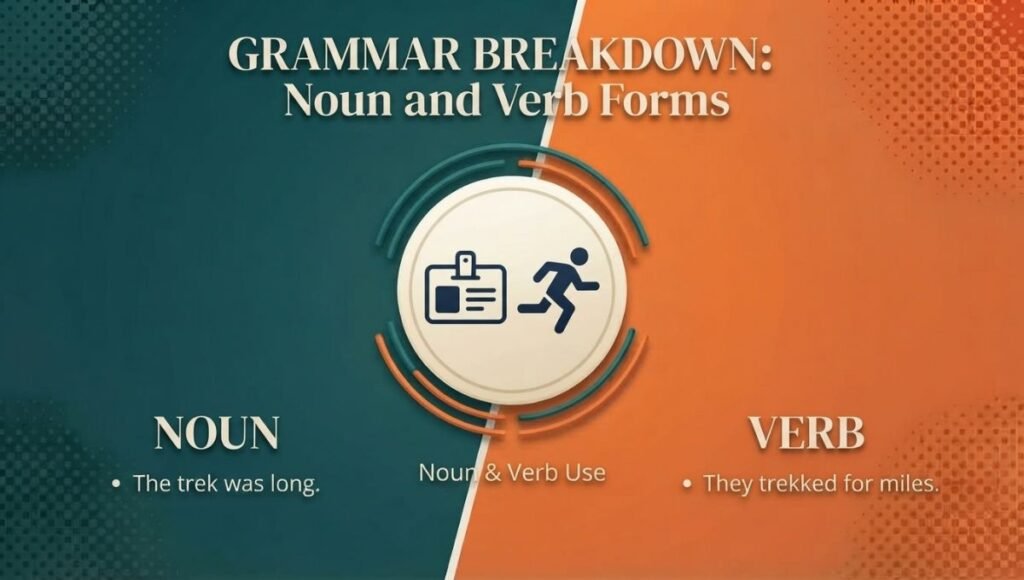
“Trek” functions as both a noun and a verb, and its forms change slightly depending on how it’s used.
As a noun: The trek took nearly six hours to complete.
As a verb (present tense): We trek through this trail every fall.
As a verb (past tense): They trekked across the desert last year.
As a verb (present participle): She’s trekking through Nepal this month.
Notice that when adding “-ed” or “-ing” to the verb form, the final consonant doubles, becoming “trekked” and “trekking.” This follows a standard English spelling rule for short verbs ending in a single consonant after a single vowel.
Where “Trek” Comes From
The word “trek” originates from Afrikaans, where it referred to a long, arduous journey, particularly one made by ox wagon during the historical migrations of Dutch settlers in South Africa. The word entered English in the 19th century and gradually broadened in meaning to describe any long, difficult journey, whether by foot, vehicle, or otherwise. Its foreign origin explains why “trek” doesn’t follow the typical English “ck” spelling pattern seen in native words like “deck” or “neck.”
How to Pronounce “Trek”
“Trek” is pronounced with a short “e” sound, rhyming with “check” and “deck,” even though the spelling differs. There’s no pronunciation confusion tied to treck or trek, since “treck” isn’t a real word to pronounce differently in the first place.
Treck or Trek: Quick Comparison Table
| Term | Correct? | Meaning | Use |
| Trek | Yes | A long, difficult journey | Standard spelling in all writing, US and UK English |
| Treck | No | Not a recognized word | Common misspelling, never appears in dictionaries |
“Trek” in Real Sentences
Everyday conversation: “That grocery run felt like a trek in this weather.”
Workplace communication: “Getting to the new office site requires a bit of a trek through construction zones.”
Academic writing: “The researchers documented the annual trek made by the migrating herd.”
Email: “Thanks for making the trek out here for the meeting, I know it’s a long drive.”
Business writing: “The company organized a corporate retreat that included a guided trek through the nearby hills.”
Casual writing: “We trekked all over the city looking for that one bookstore.”
Each of these sentences uses “trek” correctly, and none of them would work with “treck” in place of it.
Common Mistakes With Trek and Treck
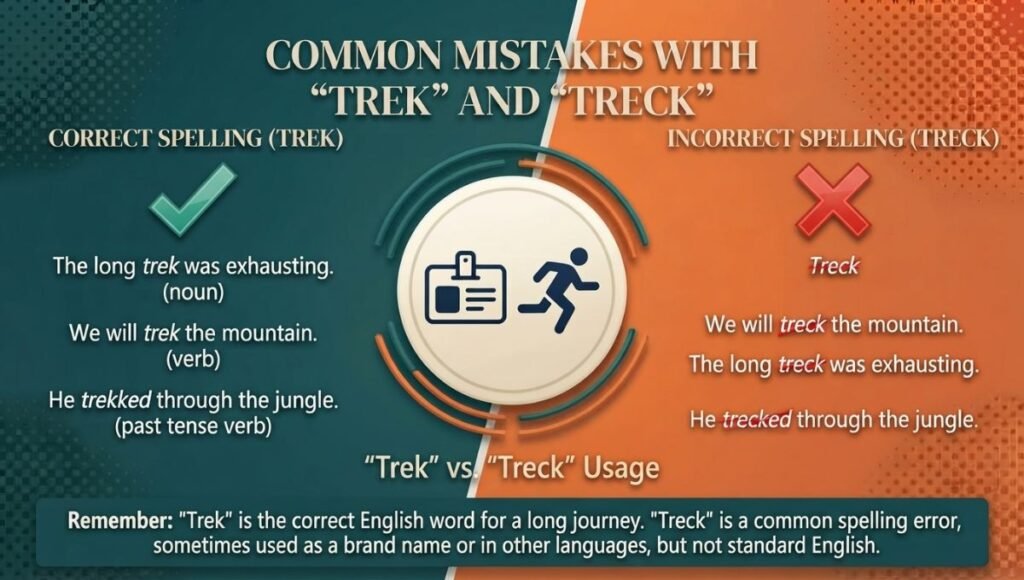
Incorrect: We went on a treck through the forest.
Correct: We went on a trek through the forest.
This is the classic treck or trek mistake, caused by applying the familiar “ck” spelling pattern from words like “check” and “deck.”
Incorrect: She trecked across Europe last summer.
Correct: She trekked across Europe last summer.
This mistake combines the incorrect spelling with the past tense form, when the correct base word is “trek,” not “treck.”
Incorrect: That was quite a treck to get here.
Correct: That was quite a trek to get here.
Even in casual, conversational writing, “trek” remains the only correct spelling, regardless of tone.
Related Words and Terms
A few related terms add useful context:
- Hike: a shorter, more casual version of a trek, often used interchangeably
- Journey: a broader term for travel, not necessarily difficult or on foot
- Expedition: a more formal or organized version of a trek, often for exploration
- Trekking: the present participle and activity form of trek, often used for hiking trips
- Voyage: typically used for travel by sea, distinct from the overland sense of trek
Knowing these related terms helps you choose the most precise word depending on the type of journey you’re describing.
How to Remember the Correct Spelling
A simple trick: think of “trek” as a short, foreign word that skipped the usual English “ck” rule entirely. Since it came from Afrikaans rather than evolving through typical English spelling patterns, it never picked up the extra “c.” Once you remember that “trek” is the exception rather than the rule, the treck or trek question won’t trip you up again.
FAQs About Treck or Trek
Is “treck” ever correct?
No. “Treck” is not found in any major dictionary and is considered a spelling error in every context, formal or informal.
Why isn’t “trek” spelled with “ck” like similar words?
“Trek” comes from Afrikaans rather than evolving through standard English spelling patterns, which is why it kept a single “k” instead of adopting the “ck” ending common in native English words.
Is “trek” both a noun and a verb?
Yes. “Trek” can describe the journey itself as a noun, or the act of traveling as a verb, such as “to trek across a mountain range.”
Is there a British English difference for “trek”?
No. “Trek” is spelled the same way in both American and British English, so there’s no regional variation to consider.
How do I use “trek” correctly in a sentence?
Use “trek” to describe a long or difficult journey, such as “The hikers began their trek at sunrise.”
The Bottom Line
The treck or trek debate has one clear answer: “trek” is correct, and “treck” is simply a spelling mistake, not an alternate form. Remember that “trek” is a borrowed word that never adopted the “ck” spelling pattern, and you’ll spell it correctly every time going forward.











1 thought on “Treck or Trek (2026): 5 Simple Facts to Fix This Common Spelling Mistake”