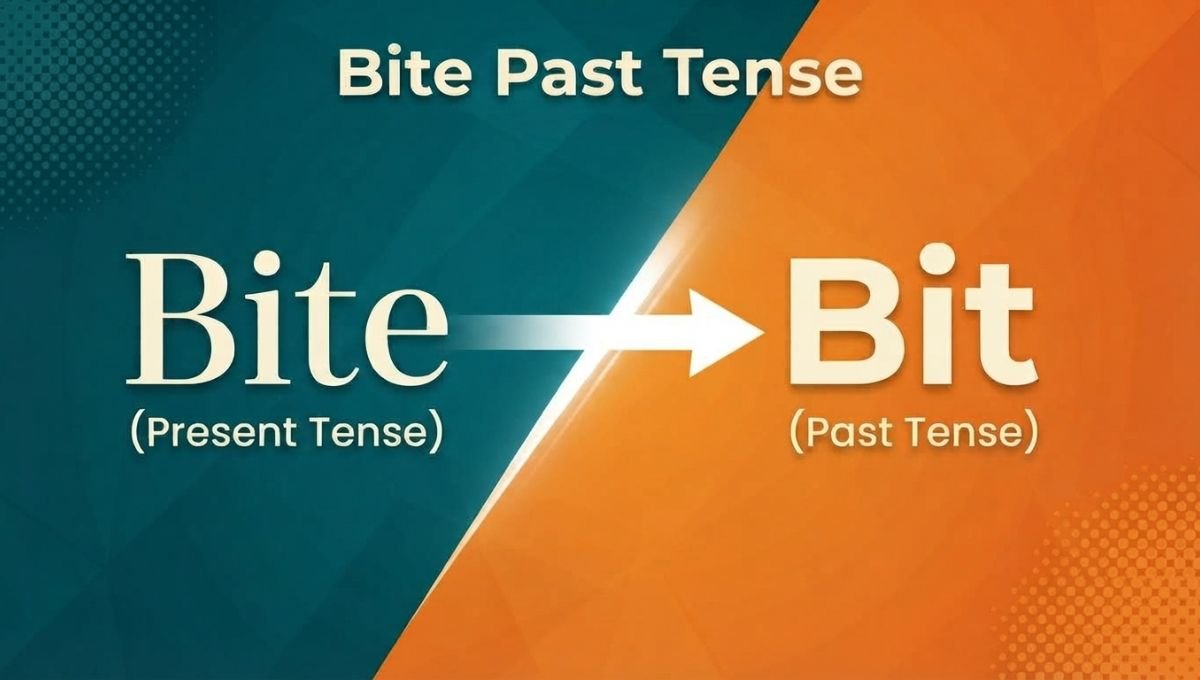
The dog “bited” someone? That doesn’t sound right, and it isn’t. The bite past tense question trips up a lot of English learners because “bite” is an irregular verb with two different past forms depending on the sentence. Here’s the quick answer: understanding the bite past tense system takes just a few minutes once you see how “bit” and “bitten” each fit into a sentence.
Quick Answer: What Is the Past Tense of Bite?
The simple past tense of “bite” is “bit.” The past participle, used with helping verbs like “has,” “have,” or “had,” is “bitten.” “Bited” is not a recognized word in any English dictionary. Whenever you need the bite past tense form, remember there are two correct options depending on the sentence structure.
What Do “Bit” and “Bitten” Mean?
Both “bit” and “bitten” come from the verb “bite,” meaning to use teeth to cut, grip, or wound something. The difference lies in when and how each form is used:
- The dog bit the mail carrier yesterday. (simple past)
- The dog has bitten three people this year. (past participle)
Both sentences describe a completed action involving biting, but the grammar structure around them determines which form is correct.
Why “Bited” Looks Right, But Isn’t
Most English learners assume every verb forms its past tense by adding “-ed,” which works for regular verbs like “walk” to “walked” or “play” to “played.” Based on that pattern, “bite” would logically become “bited.” But “bite” belongs to a group of irregular verbs that change their internal spelling instead of adding a standard ending. This is exactly why the bite past tense mistake happens so often, especially among learners still building familiarity with irregular verbs.
Bite Is an Irregular Verb With Two Past Forms
English verbs fall into two main categories: regular and irregular. Regular verbs add “-ed” to form the past tense, while irregular verbs change internally, sometimes with two separate forms for different grammatical roles.
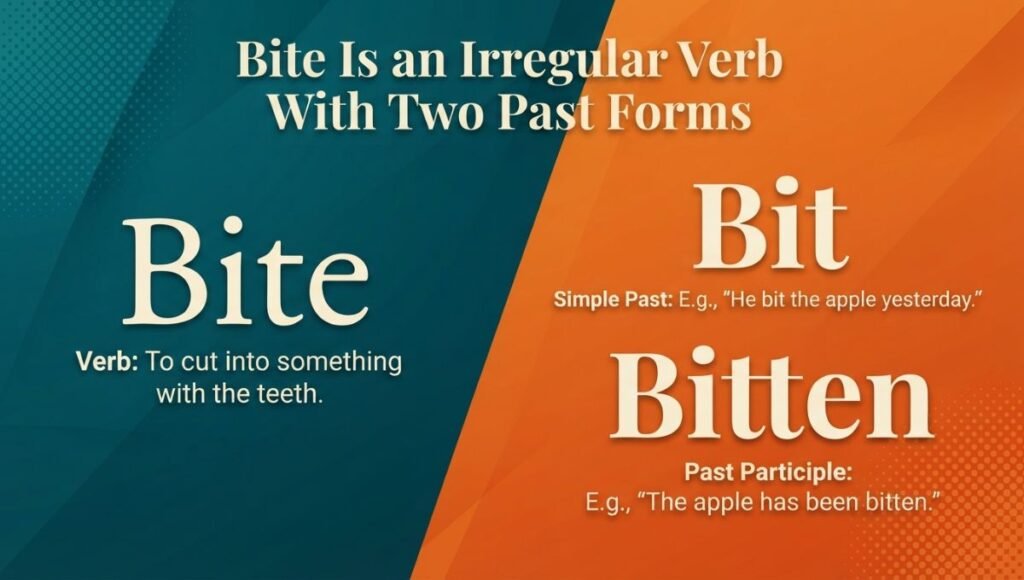
“Bite” is one of the irregular verbs that has a distinct simple past tense (“bit”) and a separate past participle (“bitten”). This pattern shows up in a small group of related irregular verbs:
- write → wrote → written
- ride → rode → ridden
- hide → hid → hidden
Each of these verbs follows the same three part pattern: base form, simple past, and past participle, all spelled differently. Recognizing that bite past tense follows this same structure makes the two forms much easier to remember.
More related Post: Keep Past Tense (2026): 5 Easy Steps to Master the Correct Form https://feastinsidar.com/keep-past-tense/
Bite, Bit, Bitten: The Full Verb Chart
Since “bite” is irregular with two past forms, it helps to see all three forms together.
| Form | Word | Example |
| Base form | bite | Please don’t let the dog bite the guests. |
| Simple past tense | bit | The dog bit the mail carrier yesterday. |
| Past participle | bitten | The mail carrier has been bitten twice this month. |
The base form is used for present or future actions. The simple past stands alone in a sentence. The past participle always needs a helping verb like “has,” “have,” “had,” or “was.”
When to Use “Bit” Versus “Bitten”
This is the part that confuses most people learning the bite past tense system. Here’s the practical rule:
Use “bit” when describing a completed action by itself, with no helping verb: She bit into the apple.
Use “bitten” when a helping verb like “has,” “have,” “had,” or “was” appears before it: She has bitten into the apple. or The apple was bitten by someone.
If you’re ever unsure which form fits, check whether a helping verb comes before it. If yes, use “bitten.” If no, use “bit.”
Is “Bited” Ever Acceptable?
No, not in standard English. “Bited” does not appear in any major dictionary and is not used in formal, academic, or professional writing. It’s a common mistake made by English learners applying the regular verb pattern to an irregular verb. There is no context, casual or formal, where “bited” is considered correct.
Grammar Breakdown: Using Bit and Bitten in Sentences
Simple past tense (bit): He bit his tongue during the meeting.
Present perfect tense (has/have bitten): I have bitten my nails since childhood.
Past perfect tense (had bitten): She had already bitten into the sandwich before noticing the mold.
Passive voice (was/were bitten): The hiker was bitten by a snake on the trail.
Notice how “bitten” always pairs with a form of “have” or “be,” while “bit” stands on its own in a simple past sentence.
Where “Bite” Comes From
The word “bite” traces back to the Old English word bitan, meaning to cut into or seize with the teeth. Its irregular past tense forms developed through natural sound changes common in Old and Middle English, a pattern shared by other verbs like “write” and “ride” that also split into separate simple past and past participle forms.
How to Pronounce “Bit” and “Bitten”
“Bit” is pronounced with a short “i” sound, rhyming with “sit” and “hit.” “Bitten” adds a second syllable, pronounced “BIT-en.” There’s no pronunciation confusion tied to the bite past tense forms, since “bited” isn’t a real word to pronounce differently in the first place.
Bite Past Tense: Quick Reference Table
| Term | Correct? | Function | Use |
| Bit | Yes | Simple past tense | Stands alone, no helping verb needed |
| Bitten | Yes | Past participle | Used with has, have, had, or was |
| Bited | No | Not a recognized word | Common mistake, never appears in dictionaries |
“Bit” and “Bitten” in Real Sentences
Everyday conversation: “My dog bit a squirrel in the backyard this morning.”
Workplace communication: “The client has bitten off more than they can handle with this project timeline.”
Academic writing: “The study found that participants had bitten their nails significantly more during stressful tasks.”
Email: “Please note the customer was bitten by our shop dog and may follow up about the incident.”
Business writing: “We’ve bitten the bullet and invested in new equipment this quarter.”
Casual writing: “I bit into the sandwich before realizing it was the wrong one.”
Each sentence uses “bit” or “bitten” correctly depending on whether a helping verb is present.
Common Mistakes With Bite, Bit, and Bitten
Incorrect: The dog bited the mailman.
Correct: The dog bit the mailman.
This is the classic bite past tense mistake, caused by applying the regular “-ed” rule to an irregular verb.
Incorrect: She has bit her nails since she was young.
Correct: She has bitten her nails since she was young.
This mistake uses the simple past instead of the past participle, which is required after “has.”
Incorrect: He was bit by a mosquito on his arm.
Correct: He was bitten by a mosquito on his arm.
Passive voice always requires the past participle, so “bitten” is correct here, not “bit.”
Related Words and Terms
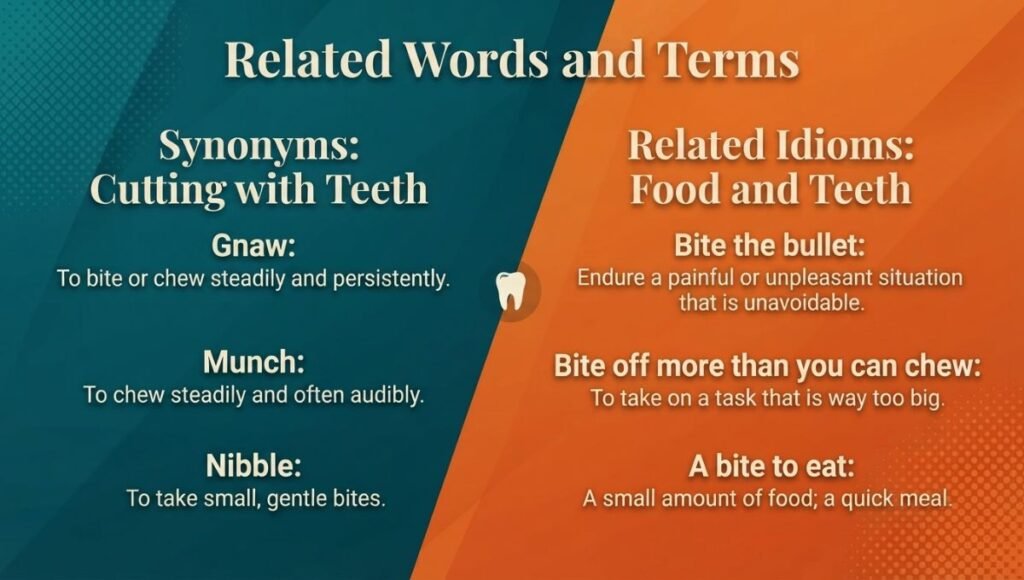
A few related terms are useful for context:
- Chew: a related action involving the teeth, but without the sharp or sudden force of a bite
- Nibble: a smaller, gentler version of biting
- Snap: often used to describe a quick, aggressive bite, especially by animals
- Irregular verb: the grammar category that “bite” belongs to
- Gnaw: a repeated biting action, often used for animals or objects
Knowing these related terms helps you choose the most precise word depending on context, rather than relying on “bite” for every situation.
How to Remember the Correct Past Tense Forms
A simple trick: group “bite” with its irregular verb family, like write, ride, and hide. Each has three distinct forms: base, simple past, and past participle. If you remember that “bit” stands alone and “bitten” always needs a helper like “has” or “was,” the bite past tense system becomes second nature.
FAQs About Bite Past Tense
Is “bited” ever correct?
No. “Bited” is not found in any major dictionary and is considered a grammar mistake in every context, formal or informal.
What is the difference between “bit” and “bitten”?
“Bit” is the simple past tense, used alone in a sentence. “Bitten” is the past participle, always used with a helping verb like “has,” “have,” “had,” or “was.”
Why is “bite” an irregular verb?
“Bite” doesn’t follow the standard “-ed” pattern used by regular verbs. Instead, it changes internally to “bit” and “bitten,” a pattern shared by verbs like “write” and “ride.”
Is there a British English difference for “bit” or “bitten”?
No. Both forms are used the same way in American and British English, so there’s no regional variation to consider.
How do I know when to use “bitten” instead of “bit”?
Use “bitten” whenever a helping verb like “has,” “have,” “had,” or “was” appears before it. Use “bit” when the verb stands alone in a simple past sentence.
The Bottom Line
The bite past tense question has a clear two part answer: use “bit” for a simple completed action, and “bitten” whenever a helping verb is involved. Once you remember that “bite” follows the same three form pattern as “write” and “ride,” choosing between “bit” and “bitten” will become second nature.











1 thought on “Bite Past Tense (2026): 5 Simple Steps to Use Bit and Bitten Correctly”