Spell check doesn’t flag either “eying” or “eyeing,” so which one is actually right? The eying or eyeing confusion happens because this is one of the rare cases where English allows two accepted spellings for the same word. Once you understand which form is more common and why both exist, the eying or eyeing question becomes much easier to navigate.
Quick Answer: Is It Eying or Eyeing?
Both “eying” and “eyeing” are correct spellings, but “eyeing” is the more common and widely preferred form in American English. “Eying” is a recognized variant, not a mistake, though it appears far less often in published writing, dictionaries, and everyday use.
What Does “Eyeing” Mean?
“Eyeing” (or “eying”) is the present participle of the verb eye, meaning to look at something or someone closely, often with interest, suspicion, or desire. Both spellings carry the exact same meaning:
- She kept eyeing the last slice of pizza.
- He was eying a promotion at work.
There is no difference in meaning between the two spellings. The only difference is which one shows up more often in writing.
Why Two Spellings Exist for the Same Word
Most English verbs ending in a silent “e” drop that “e” before adding “-ing,” which is why “make” becomes “making” and “hope” becomes “hoping.” Based on that rule, “eye” should become “eying.” And it does, that spelling is valid.
But English also allows some short verbs to keep the “e” when dropping it would create an unusual or hard to read letter combination. “Eyeing” keeps the double “e” pattern, which many writers and editors find clearer and easier to recognize at a glance. This is the real reason behind the eying or eyeing split.
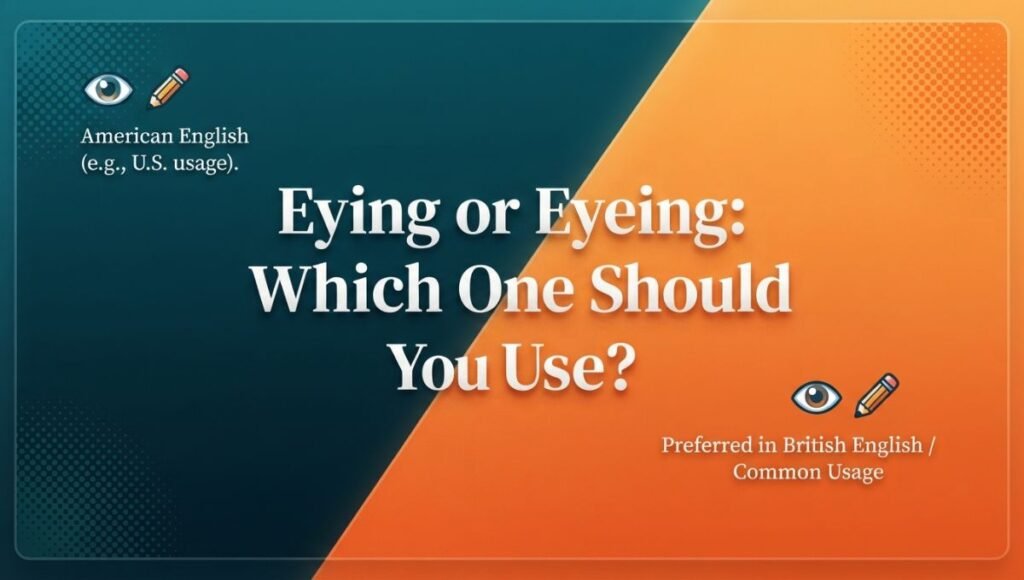
Eying or Eyeing: Which One Should You Use?
Here’s the practical guidance:
Use “eyeing” in most everyday writing, business communication, and published content, since it’s the more widely recognized and expected spelling.
Use “eying” only if you prefer the shorter form or you’re following a specific style guide or publication that favors it. It’s grammatically valid, just less common.
If you’re unsure about eying or eyeing in a formal document, choose “eyeing” to match reader expectations.
Is “Eying” Considered Incorrect?
No. “Eying” is not incorrect, and it appears in major dictionaries as an accepted variant of “eyeing.” It’s simply the less frequently used spelling. Some readers may pause slightly when they see “eying” because it’s unfamiliar, which is a practical reason to default to “eyeing” in most writing, even though both are technically correct.
More related Post: Wifes or Wives: 5 Simple Rules to Get the Plural Right (2026) https://feastinsidar.com/wifes-or-wives/
Grammar Breakdown: Verb Forms of “Eye”
“Eye” functions as both a noun (the body part) and a verb (to look at closely). As a verb, here are its forms:
| Form | Spelling | Example |
| Base | eye | I eye the dessert table every party. |
| Present participle | eyeing / eying | She’s eyeing that new job. |
| Past tense | eyed | He eyed the stranger suspiciously. |
| Past participle | eyed | The house had been eyed by several buyers. |
Only the present participle form has two accepted spellings. The past tense and past participle stay consistent as “eyed” regardless of which present participle spelling you prefer.
Where “Eye” Comes From
The word “eye” comes from Old English ēage, referring to the organ of sight. Its extended meaning, to look at or watch something closely, developed naturally over time as the noun took on verb uses in Middle English. The spelling variation between “eying” and “eyeing” reflects a broader pattern in English where short verbs ending in a vowel sometimes resist the standard “drop the e” rule to avoid awkward or confusing spellings.
How to Pronounce “Eyeing” and “Eying”
Both spellings are pronounced exactly the same way: EYE-ing, with two syllables. There is no pronunciation difference tied to eying or eyeing, since the spelling variation exists purely on the page, not in speech.
Eying or Eyeing: Quick Comparison Table
| Term | Correct? | Frequency | Use |
| Eyeing | Yes | Most common | Preferred in everyday, business, and published writing |
| Eying | Yes | Less common | Accepted variant, seen occasionally in casual or stylistic writing |
“Eyeing” and “Eying” in Real Sentences
Everyday conversation: “He’s been eyeing that new phone for weeks.”
Workplace communication: “The team has been eyeing a bigger office space for next year.”
Academic writing: “Researchers have been eyeing new methods to reduce energy consumption.”
Email: “I noticed you’ve been eyeing the senior analyst position, so let’s chat about it.”
Business writing: “Investors are eyeing the company’s next quarterly report closely.”
Casual writing (using the less common spelling): “She’s eying a new apartment closer to downtown.”
Both spellings work grammatically in every context above, though “eyeing” reads more naturally to most audiences.
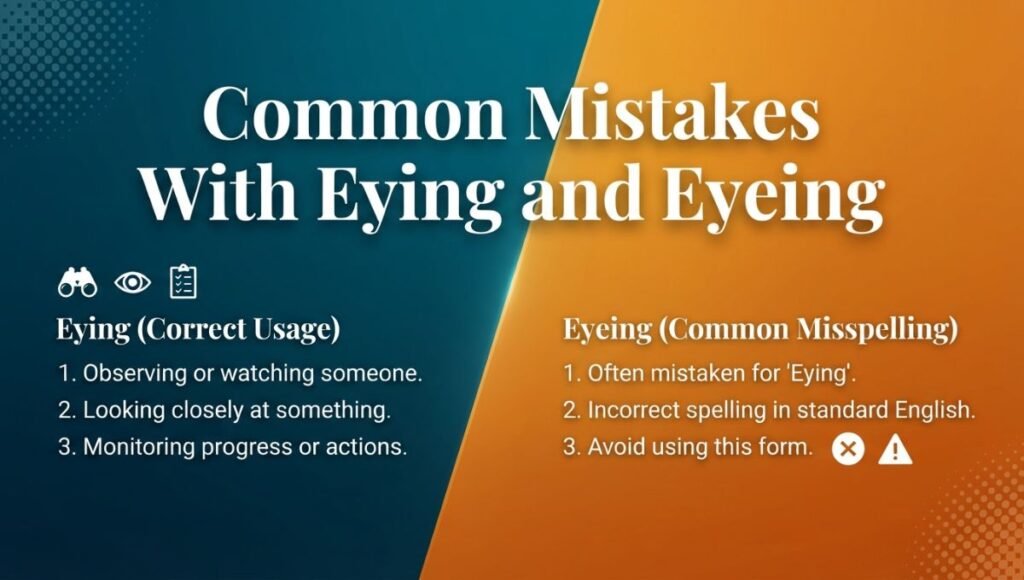
Common Mistakes With Eying and Eyeing
Incorrect: He is eyeng the last cookie on the plate.
Correct: He is eyeing the last cookie on the plate.
This mistake happens when writers drop a letter by accident, landing on a spelling that isn’t valid in either accepted form.
Incorrect: They were eyeing eachother across the room.
Correct: They were eyeing each other across the room.
This isn’t related to the eying or eyeing spelling itself, but it’s a common companion mistake in the same type of sentence.
Incorrect: She has eyed on that car for months.
Correct: She has had her eye on that car for months.
“Eyed on” isn’t standard English. The correct idiom uses “eye on,” paired with a form of “have.”
Related Words and Terms
A few related terms add useful context:
- Watch: a more neutral synonym for looking at something closely
- Observe: a formal synonym often used in academic or professional writing
- Covet: implies a stronger desire than simply “eyeing” something
- Suspicious: often paired with “eyeing” when the look implies distrust
- Eye contact: a related phrase using “eye” as a noun
How to Remember Which Spelling Fits Best
A simple guideline: when in doubt, add the extra “e” and go with “eyeing.” It’s the safer, more recognized choice for nearly any writing situation. Save “eying” for casual writing or specific style preferences, and you’ll navigate the eying or eyeing choice with confidence every time.
FAQs About Eying or Eyeing
Is “eying” a misspelling of “eyeing”?
No. “Eying” is a recognized, dictionary approved variant of “eyeing,” not a spelling error.
Which spelling is more common, eying or eyeing?
“Eyeing” is significantly more common in American English and is the preferred choice for most formal and professional writing.
Can I use “eying” in a school essay or professional document?
You can, since it’s grammatically correct, but “eyeing” is generally the safer choice because it’s more familiar to readers.
Does British English prefer a different spelling?
Both British and American English accept both spellings, with “eyeing” remaining the more frequently used form in both.
What does “eyeing” mean in a sentence?
It means looking at something or someone closely, often with interest or suspicion, as in “She kept eyeing the clock during the meeting.”
The Bottom Line
The eying or eyeing question doesn’t have a single right answer, since both spellings are grammatically valid. Stick with “eyeing” for most writing situations, and remember that reaching for the more familiar spelling will almost always serve your readers better.










1 thought on “Eying or Eyeing: 5 Facts That Settle Which Spelling to Use (2026)”