Seeing “Brasil” on a soccer jersey and “Brazil” in your English textbook can feel like someone made a typo. Neither one did. The Brasil or Brazil confusion exists because the country has one official name in Portuguese and a different accepted spelling in English. Once you understand the reason behind this, the Brasil or Brazil debate becomes easy to settle.
Quick Answer: Is It Brasil or Brazil?
“Brazil” is the correct spelling in English, and it’s the form used in American and British writing, news, textbooks, and official documents. “Brasil” is the correct spelling in Portuguese, the country’s official language, and it’s what appears on Brazilian passports, currency, and government documents. When people ask whether it’s Brasil or Brazil, the honest answer is that both are correct, just in different languages.
What Do “Brasil” and “Brazil” Actually Mean?
Both words refer to the same country: the largest nation in South America, known for the Amazon rainforest, Rio de Janeiro, and Portuguese as its official language. The difference isn’t in meaning. It’s purely a matter of spelling convention between two languages.
- Brazil (English): Brazil is home to the Amazon River.
- Brasil (Portuguese): O Brasil é o maior país da América do Sul.
Why English Uses “Z” Instead of “S”
This is the part that confuses most English speakers. In English, the letter z commonly appears in place of an s when adapting foreign place names, especially those with Latin or Iberian roots. This happened with several country names as they were absorbed into English over centuries, and it’s a big reason the Brasil or Brazil spelling split exists at all.
Portuguese, by contrast, keeps the original s spelling, which is why “Brasil” looks correct to Portuguese speakers and slightly foreign to English speakers.
Brasil or Brazil: When Each Spelling Applies
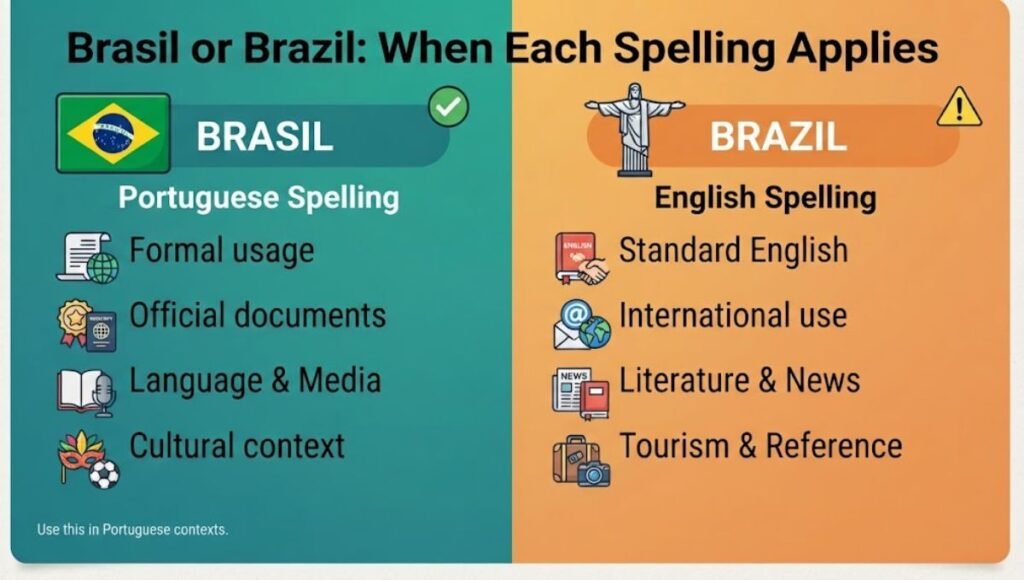
Here’s the practical rule:
Use “Brazil” when writing in English: news articles, emails, business documents, school papers, or everyday conversation.
Use “Brasil” when writing in Portuguese, quoting an official Brazilian document, referencing the country’s official name directly, or discussing branding tied specifically to Brazil (such as certain product labels or cultural references).
If you’re debating Brasil or Brazil for a school essay or professional report written in English, always choose “Brazil.”
Is “Brasil” Ever Acceptable in English Writing?
Yes, in specific situations. “Brasil” appears in English text when:
- Quoting the country’s official name in Portuguese
- Referencing a Brazilian brand, team name, or organization that uses “Brasil” in its own branding
- Discussing the country’s constitution or government, which is officially called the República Federativa do Brasil
Outside of these specific cases, English writing should default to “Brazil.”
More related Post : High School or Highschool: The Correct Spelling in 2026 https://feastinsidar.com/high-school-or-highschool/
Grammar Notes: Proper Noun Rules
“Brazil” and “Brasil” are both proper nouns, meaning they always start with a capital letter regardless of where they appear in a sentence. Since they name a specific country, they follow the same capitalization rules as other proper nouns like “France” or “Japan.”
Neither word has a plural form, and neither functions as a verb or adjective on its own. The adjective form in English is Brazilian (Brazilian coffee, a Brazilian citizen), which also uses the “z” spelling, consistent with the English version of the name.
Where the Name “Brazil” Comes From
The name originates from pau brasil, a Portuguese term for a reddish wood (“brazilwood”) that early European traders exported in large quantities from the region. Because the wood was such a significant part of early trade, the land itself eventually became known by the wood’s name. As the term moved into English, the spelling shifted from the Portuguese “s” to the English “z,” following the same pattern seen in other adapted place names.
How to Pronounce Brazil and Brasil
Brazil (English): pronounced “bruh-ZIL,” with stress on the second syllable.
Brasil (Portuguese): pronounced “bra-ZEEW” in Brazilian Portuguese, with a softer ending sound than the English version.
The pronunciation difference is subtle but noticeable, and it reflects the natural sound patterns of each language rather than any spelling error.
Brasil or Brazil: Quick Comparison Table
| Term | Correct? | Language | Use |
| Brazil | Yes | English | Standard spelling in all English writing, news, and education |
| Brasil | Yes | Portuguese | Official spelling in Portuguese, used in Brazil’s own documents and branding |
“Brazil” and “Brasil” in Real Sentences
Everyday conversation: “I’m planning a trip to Brazil next summer.”
Workplace communication: “Our new distributor is based in Brazil and will handle South American shipping.”
Academic writing: “Brazil has the largest economy in South America.”
Email: “Please confirm whether the shipment to Brazil has cleared customs.”
Business writing: “The company is expanding operations into Brazil this fiscal year.”
Referencing official Portuguese branding: “The jersey reads ‘Brasil’ across the front, matching the national team’s official name.”
Common Mistakes With Brasil and Brazil
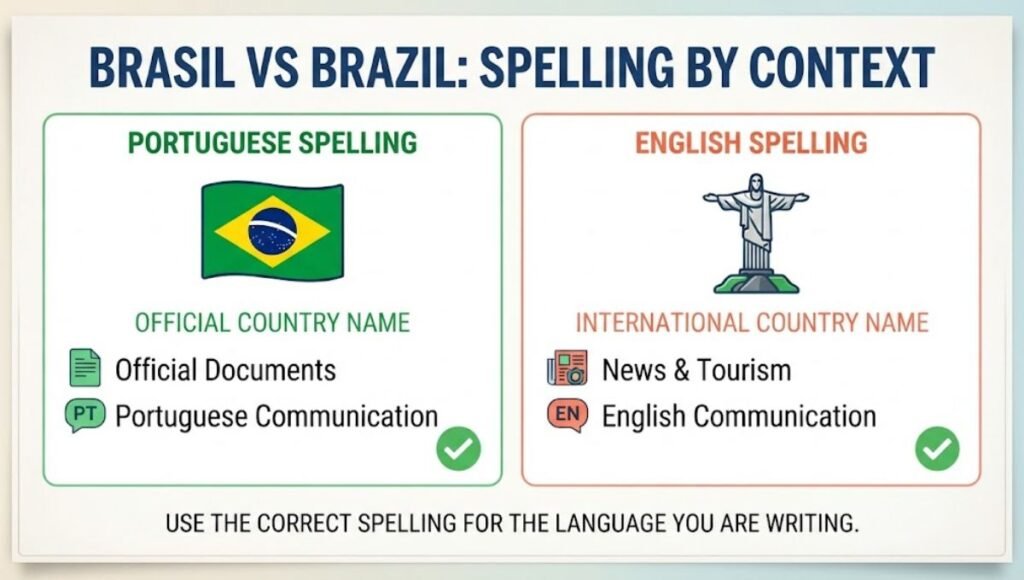
Incorrect: I’m traveling to Brasil next month. (in an English sentence)
Correct: I’m traveling to Brazil next month.
This mistake happens because “Brasil” is widely seen on flags, jerseys, and social media, making it feel just as familiar as the English spelling.
Incorrect: The Brasilian government announced new trade policies.
Correct: The Brazilian government announced new trade policies.
The adjective form in English always uses “z,” even when the noun form might occasionally appear as “Brasil” in branding.
Incorrect: He works for a company based in Brazil, called “Cafe do Brazil.”
Correct: He works for a company based in Brazil, called “Cafe do Brasil” (if that’s the business’s actual Portuguese name).
When referencing an official Portuguese name or brand, keep the original Portuguese spelling intact rather than anglicizing it.
Related Words and Terms
A few related terms add useful context:
- Brazilian: the adjective and demonym form, always spelled with a “z”
- Portuguese: the official language of Brazil
- South America: the continent Brazil is part of
- Brasília: Brazil’s capital city, which keeps the Portuguese “s” spelling
- Amazonia: the rainforest region largely located within Brazil
How to Remember Which Spelling to Use
A simple way to remember: if you’re writing in English, reach for the z. If you’re quoting Portuguese text, an official document, or a Brazilian brand name, keep the s. Think of it as switching spelling the same way you’d switch languages, since that’s exactly what’s happening.
FAQs About Brasil or Brazil
Is “Brasil” a misspelling of “Brazil”?
No. “Brasil” is the correct Portuguese spelling, while “Brazil” is the correct English spelling. Neither is a mistake in its own language.
Why does English spell it with a “z” instead of an “s”?
English commonly adapts foreign place names by replacing certain letters, and “Brazil” follows that pattern rather than keeping the original Portuguese spelling.
Which spelling should I use in a school essay?
Use “Brazil” for any essay, report, or document written in English.
Is “Brazilian” spelled with an “s” or a “z”?
Always with a “z.” The adjective form is “Brazilian,” matching the English spelling of the country name.
Does Brazil’s official name use “Brasil” or “Brazil”?
Brazil’s official Portuguese name is República Federativa do Brasil, using the Portuguese spelling with an “s.”
The Bottom Line
The Brasil or Brazil question comes down to language, not correctness. Use “Brazil” for English writing and “Brasil” when referencing the country’s Portuguese name or official branding, and you’ll never second guess which spelling belongs where again.











1 thought on “Brasil or Brazil: 5 Key Facts to Clear Up the Confusion (2026)”