Typing “lieing” feels natural, so why does spell check keep flagging it? This happens because most people apply the standard -ing rule without knowing that verbs ending in -ie follow a different pattern. The lieing or lying question confuses students, professionals, and even native speakers who never learned this specific spelling rule. The good news: once you understand why lieing or lying trips people up, you’ll never misspell it again.
Quick Answer: Is It Lieing or Lying?
If you’ve typed “lieing” and something felt off, your instinct was right. The correct spelling is always “lying.” “Lieing” is not a recognized English word in any dictionary, and it never appears in professional or academic writing. The lieing or lying confusion comes from a simple spelling rule that most people never learned explicitly, and once you see it, you won’t forget it.
What Does “Lying” Mean?
“Lying” is the present participle (the -ing form) of the verb lie. It has two separate meanings depending on context:
- To say something untrue on purpose: She was lying about her age.
- To be in a horizontal, resting position: The cat is lying on the couch.
Both meanings use the exact same spelling, “lying,” even though they come from two different base verbs (lie, meaning to deceive, and lie, meaning to recline). This is one reason the word trips people up.
Why “Lieing” Looks Right, But Isn’t
Most English learners assume you just add -ing to the end of a verb, no changes needed. That works for words like walk to walking or jump to jumping. But lie ends in a vowel-consonant combination that doesn’t follow that pattern, and the -ing rule for words ending in ie is different.
When a verb ends in ie, English spelling rules require you to change the ie to a y before adding -ing. That single rule explains the entire lieing or lying debate.
The Spelling Rule Behind Lie to Lying
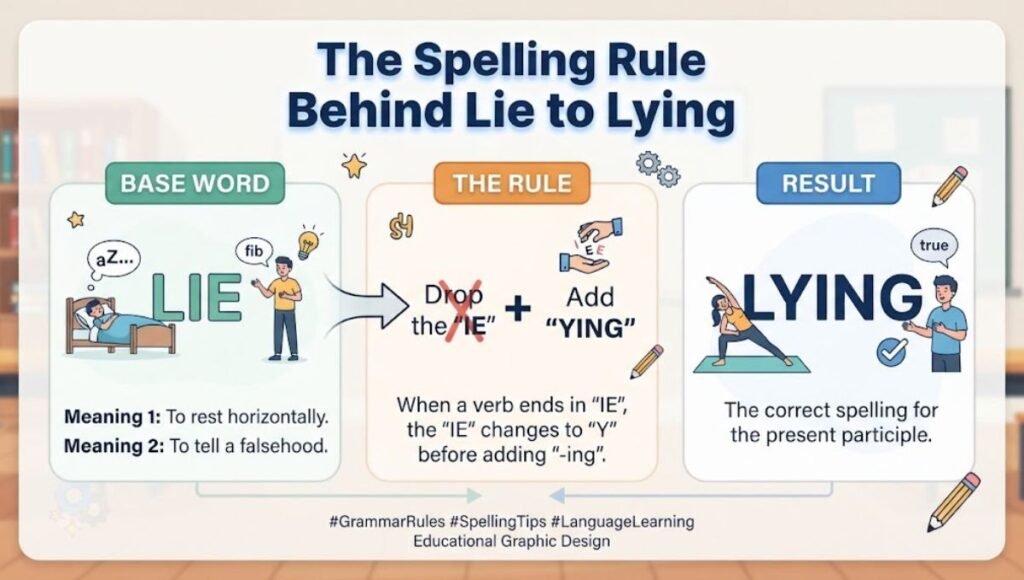
Here’s the rule in plain terms:
If a verb ends in -ie, drop the e and change the i to y, then add -ing.
So the transformation looks like this:
- lie → ly + ing → lying
This same rule applies to other common -ie verbs, which is helpful for spotting the pattern:
- die → dying
- tie → tying
- vie → vying
None of these become “dieing,” “tieing,” or “vieing.” If you remember that “lying” follows the same family of words as “dying” and “tying,” the spelling becomes much easier to lock in.
Lie, Lying, Lied, Lies: The Full Verb Chart
Since “lie” has two distinct meanings, its other verb forms differ depending on which “lie” you mean. Here’s a clear breakdown:
| Base Form | Meaning | Present Participle | Past Tense | Past Participle |
| lie | to say something false | lying | lied | lied |
| lie | to recline | lying | lay | lain |
Notice that “lying” is identical in both cases. The difference only shows up in the past tense, where “lied” (deception) and “lay” (reclining) go their separate ways. This is a common source of extra confusion, so keep the two meanings mentally separate when you’re choosing past tense forms.
More related Post: Registration for ETSGameEvent: Complete Step-by-Step Guide 2026 https://feastinsidar.com/registration-for-etsgameevent-meaning/
A Quick Look at Where “Lie” Comes From
The verb “lie” has roots in Old English. The deception sense traces back to the Old English word leogan, meaning to deceive or tell falsehoods, while the reclining sense comes from a related but separate Old English root, licgan. Over centuries, English spelling settled into the lie/lying/lied and lie/lying/lay/lain patterns we use today. The -ing spelling rule itself (changing ie to y) developed as a general convention to keep double vowels and awkward letter combinations out of English spelling.
How to Pronounce “Lying”
“Lying” is pronounced LY-ing, with two syllables: rhymes with “trying” and “flying.” There’s no separate pronunciation issue tied to the lieing or lying question since “lieing” isn’t a real word to pronounce in the first place. If you see “lieing” written anywhere, treat it purely as a spelling error, not an alternate pronunciation or regional variant.
Lieing vs Lying: Quick Comparison Table
| Term | Correct? | Meaning | Use |
| Lying | Yes | Telling a falsehood, or reclining | Standard spelling in all contexts, US and UK English |
| Lieing | No | Not a word | Common misspelling, never appears in dictionaries |
There’s no formal or informal exception here. Unlike some grammar debates where both forms are technically acceptable, this one has a single correct answer.
“Lying” in Real Sentences
Seeing the word used naturally helps it stick. Here are examples across different everyday contexts:
Everyday conversation: “Stop lying to me about where you were last night.”
Workplace communication: “The manager confronted the employee about lying on his timesheet.”
Academic writing: “The study examined why children develop the habit of lying at an early age.”
Email: “I want to clarify that I wasn’t lying when I said the report was finished.”
Business writing: “Lying to clients about product performance can lead to serious legal consequences.”
Casual writing: “My dog is just lying there in the sun like he owns the place.”
Each of these sentences uses “lying” correctly, and none of them would work with “lieing” in place of it.
Common Mistakes With Lie and Lying
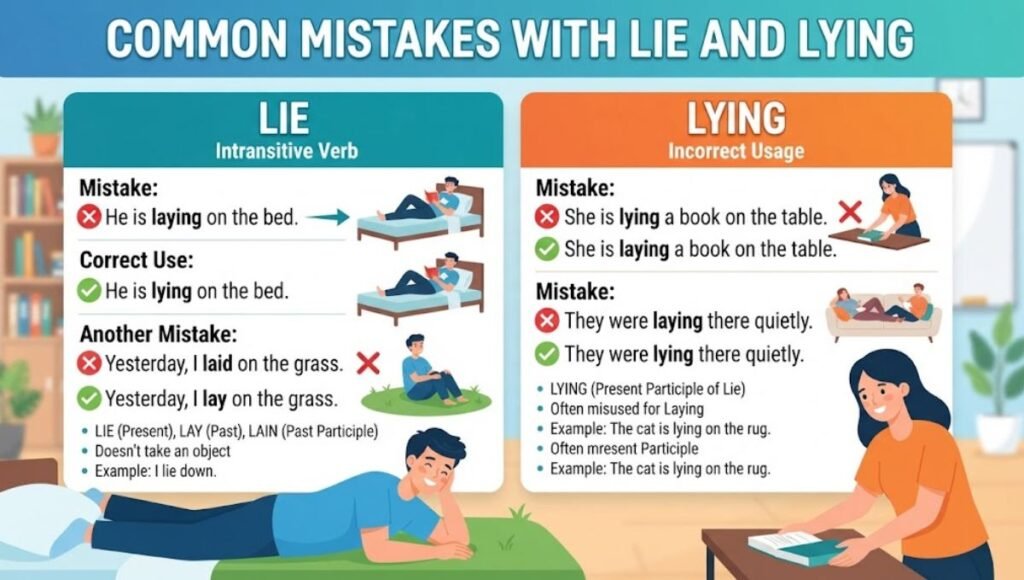
Incorrect: He was lieing about his whereabouts.
Correct: He was lying about his whereabouts.
This is the classic lieing or lying mistake, and it happens because writers apply the standard -ing rule without accounting for the ie to y switch.
Incorrect: The book is laying on the table.
Correct: The book is lying on the table.
This mix up happens because “lay” and “lie” are often confused. “Lay” needs a direct object (you lay something down), while “lie” does not.
Incorrect: She lied on the beach all afternoon.
Correct: She lay on the beach all afternoon.
“Lied” only applies to telling falsehoods. For reclining, the past tense is “lay,” not “lied.”
Words Often Confused With Lying
A few related terms are worth knowing so you can use precise language:
- Fib: a small, often harmless lie
- Deceive: to mislead someone deliberately
- Recline: a more formal synonym for lying down
- Untruthful: an adjective describing someone who lies
- Lay: often confused with lie, but requires an object
Understanding these related words helps you choose the most accurate term for a given situation, rather than defaulting to “lying” every time.
How to Remember the Correct Spelling
If you want a mental shortcut, think of the “ie to y” family together: die, tie, vie, lie. All four become dying, tying, vying, lying. None of them keep the ie. Once this pattern clicks for one word, it applies automatically to the rest, and the lieing or lying question stops being a question at all.
FAQs About Lieing or Lying
Is “lieing” ever correct?
No. “Lieing” is not found in any major dictionary and is considered a spelling error in every context, formal or informal.
Why does “lie” become “lying” instead of “lieing”?
Verbs ending in -ie drop the e, change the i to y, and then add -ing. This rule applies to lie, die, tie, and vie.
Is “lying” the same word for both meanings of “lie”?
Yes. Whether you mean telling an untruth or reclining, the present participle is spelled “lying” in both cases.
What is the past tense of “lying”?
It depends on the meaning. For deception, the past tense is “lied.” For reclining, the past tense is “lay.”
Is there a British English difference for “lying”?
No. “Lying” is spelled the same way in both American and British English, so there’s no regional variation to worry about here.
The Bottom Line
The lieing or lying debate has one clear winner: lying is correct, and “lieing” is a spelling mistake, not an alternate form. Once you remember that verbs ending in -ie swap the i and e before adding -ing, words like lying, dying, and tying will never trip you up again.











1 thought on “Lieing or Lying: The Correct Spelling Explained in 60 Seconds (2026 Guide)”