Torn between paid attention or payed attention? The confusion is understandable, but only one of these is correct in this context. Here is the direct answer: paid attention is correct. “Payed” is a real word, but it only applies to nautical usage, never to attention, focus, or everyday spending.
The Quick Answer: Paid Attention Is Correct
Paid attention is the only correct form when describing focus, awareness, or concentration. “Payed” exists as a legitimate spelling, but it is reserved for a narrow nautical meaning, letting out a rope or cable, not for anything related to attention.
Why People Confuse Paid Attention or Payed Attention
The confusion around paid attention or payed attention stems from an old spelling pattern. Many English verbs ending in “ay” once had a “-ed” past tense spelled with a “y,” similar to “played” or “stayed.” Because “pay” looks like it should follow that same pattern, writers sometimes assume “payed” is the standard past tense, when in fact “paid” became the standard form centuries ago.
What Does “Paid” Mean?
Paid is the standard past tense and past participle of the verb “pay.” It applies to every common meaning of “pay,” including handing over money, fulfilling an obligation, and, most relevant here, directing focus toward something.
- “She paid the bill before leaving the restaurant.”
- “He finally paid attention to the warning signs.”
What Does “Payed” Mean?
Payed is a rare, specialized spelling used almost exclusively in nautical and maritime contexts. It refers to letting out a rope, chain, or cable, usually with the phrase “payed out.”
- “The sailors payed out the anchor line slowly.”
- “The cable was payed out over several hundred feet.”
Outside of this narrow nautical sense, “payed” is considered nonstandard and incorrect.
Paid Attention vs Payed Attention: The Real Difference
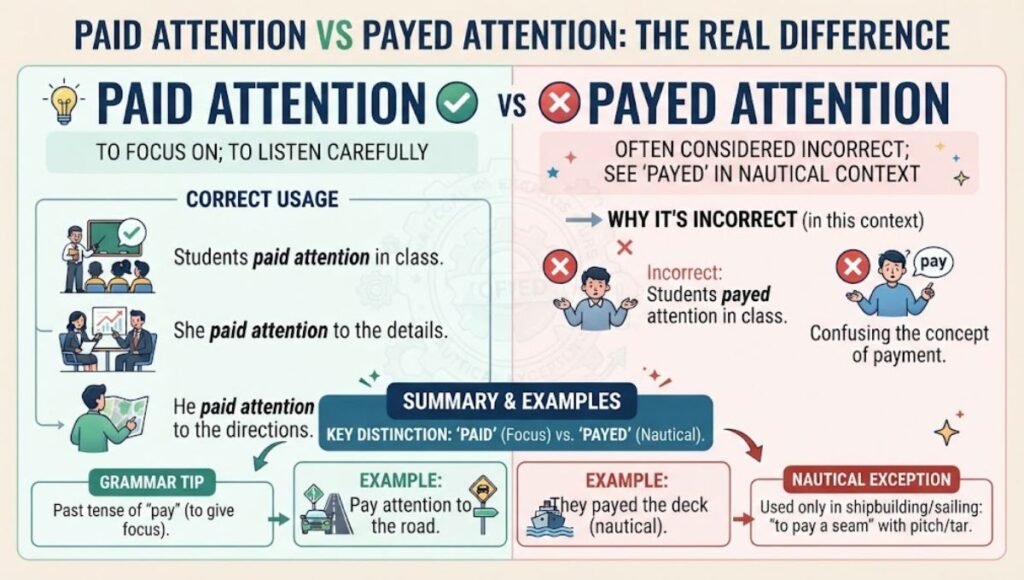
This is where paid attention or payed attention gets settled for good. “Attention” is not a rope, a cable, or anything you let out gradually, so the nautical spelling never applies here. Whenever “pay” or “paid” connects to attention, money, respect, or any figurative meaning, “paid” is the only correct choice.
Grammar Breakdown: Verb Tense and Usage
“Pay” is an irregular verb. Its past tense and past participle do not follow the regular “-ed” pattern used by verbs like “played” or “stayed.” Instead, “pay” shifts to “paid” in nearly every context.
- Present tense: “I pay attention in class.”
- Past tense: “I paid attention yesterday.”
- Past participle: “I have paid attention all semester.”
- Present participle: “I am paying attention right now.”
Notice that “paying” keeps the “y,” but the past forms switch to “paid.” This shift is exactly why the paid attention or payed attention confusion happens so often.
More related Post: Auntie or Aunty: What’s the Right Word to Use in 2026? https://feastinsidar.com/auntie-or-aunty/
Where Does “Payed” Come From?
“Payed” survives today as a specialized term in nautical vocabulary, tracing back to an older English spelling of the verb “pay” that was common before “paid” became standardized as the general past tense form. Maritime language often preserves older spellings and terms that fell out of use elsewhere, which is why “payed” still appears in sailing manuals and nautical writing, even though “paid” took over everywhere else in modern English.
How to Pronounce Paid and Payed
Both words are pronounced identically: “PAYD,” rhyming with “made” or “played.” Pronunciation offers no clue for choosing between paid attention or payed attention, which is part of why the mistake is so easy to make in writing, even for confident speakers.
Paid Attention or Payed Attention: Comparison Table
| Term | Correct? | Context | Example |
| Paid attention | Yes | Everyday, general use | “He paid attention to every detail.” |
| Payed attention | No | Not applicable | Incorrect in all cases |
| Payed (rope, cable) | Yes | Nautical only | “They payed out the rope slowly.” |
How to Use Paid Attention in a Sentence
Since paid attention is the correct and standard phrase, it fits naturally across nearly every writing context.
- Everyday conversation: “I wish I had paid attention during the meeting.”
- Workplace email: “Please make sure everyone has paid attention to the updated deadline.”
- Academic writing: “Students who paid attention during lectures performed better on exams.”
- Formal writing: “The board paid close attention to the financial report before voting.”
Each example uses “paid” correctly as the past tense of “pay,” regardless of tone or formality.
Common Mistakes With Paid Attention or Payed Attention
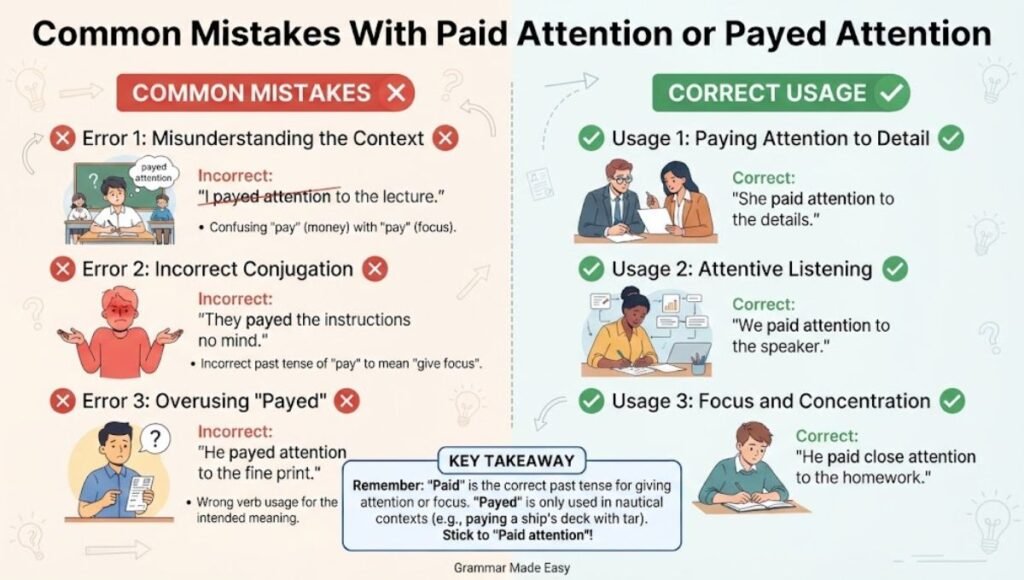
Even careful writers occasionally slip on this one, especially in fast typing or casual messages.
Incorrect: “I payed attention to what she said.”
Correct: “I paid attention to what she said.”
“Payed” is never correct for attention, since this meaning always requires the standard past tense “paid.”
Incorrect: “He payed for the tickets online.”
Correct: “He paid for the tickets online.”
Financial transactions always use “paid,” never “payed.”
Incorrect: “They payed him a compliment.”
Correct: “They paid him a compliment.”
Figurative expressions like “pay a compliment” follow the same standard rule as “pay attention.”
Related Words and Phrases
A few related terms help reinforce the paid attention or payed attention rule.
- Pay heed: a more formal synonym for paying attention.
- Pay respects: another figurative use of “pay,” also using “paid” in the past tense.
- Payee: a noun referring to a person who receives payment, unrelated to the verb spelling debate.
- Underpaid or overpaid: compound forms that also rely on the standard “paid” spelling.
When Is “Payed” Ever Correct?
“Payed” is correct only in nautical writing, specifically when describing a rope, cable, chain, or line being let out. If your sentence involves sailing, rigging, or anchoring, “payed out” is appropriate. In every other situation, including attention, money, respect, or compliments, “paid” is the form you need.
FAQs About Paid Attention or Payed Attention
Is paid attention or payed attention correct?
“Paid attention” is correct. “Payed attention” is never correct, in any context.
Is “payed” ever a real word?
Yes, but only in nautical usage, referring to letting out a rope or cable, as in “payed out the line.”
What is the past tense of “pay”?
The past tense of “pay” is “paid” in virtually all situations, including attention, money, and figurative expressions.
Why do people write “payed” instead of “paid”?
Writers often assume “pay” follows the same “-ed” pattern as verbs like “played” or “stayed,” but “pay” is irregular and uses “paid” instead.
How do I use “paid attention” in a sentence?
Use it to describe focus or awareness, such as: “She paid attention to the instructions before starting the project.”
Conclusion
Between paid attention or payed attention, only one is ever correct for describing focus or awareness: paid attention. Remember that “payed” belongs to sailors and their ropes, while “paid” belongs to everything else, including your attention.










1 thought on “Paid Attention or Payed Attention: Meaning, Grammar & Usage Guide 2026”