Wondering about auntie or aunty? You are dealing with one of the few genuine either-or spelling situations in English. Unlike true error pairs, both spellings are correct, but they are not used equally in every English-speaking country. Here is the quick answer: auntie is more common in American English, while aunty is more common in British, Australian, and South Asian English.
The Quick Answer: Both Spellings Are Correct
Auntie or aunty, take your pick, because both are accepted informal variations of “aunt.” Neither spelling is a grammar mistake. The choice mostly comes down to regional preference and personal or family habit rather than a strict rule.
Why Auntie or Aunty Causes So Much Confusion
Most English spelling debates involve one right answer and one wrong one, like “advise” versus “advice.” Auntie or aunty is different because dictionaries list both spellings as valid. That dual acceptance is exactly what confuses readers searching for a definitive answer, since they expect one version to be marked incorrect.
What Does Auntie Mean?
Auntie is an informal, affectionate variant of “aunt,” referring to the sister of one’s parent, or the wife of one’s uncle. It can also be used more loosely as a warm term for a close family friend.
- “My auntie is coming to visit next week.”
- “Say hello to Auntie Sarah.”
What Does Aunty Mean?
Aunty carries the exact same meaning as auntie. It refers to the same family relationship and is used in the same affectionate, informal way. The only difference is the spelling.
- “My aunty makes the best curry in the family.”
- “Aunty Priya taught me how to cook.”
Auntie vs Aunty: Is There a Real Difference?
There is no difference in meaning, grammar, or pronunciation between the two. The auntie or aunty distinction is purely orthographic, meaning it exists only in how the word is written, not in what it communicates. Both function as nouns and both work identically in a sentence.
More related Post: Advise or Advice: What’s the Difference and How to Use Them? (2026 Guide) https://feastinsidar.com/advise-or-advice/
Regional Usage: American, British, and Beyond
This is where auntie or aunty actually matters for writers. Regional convention shapes which spelling readers expect to see.
- American English: “Auntie” is the more frequently used spelling, especially in casual writing, children’s books, and everyday speech.
- British English: “Aunty” appears more often, though “auntie” is also widely accepted and used.
- Australian English: “Aunty” is common and, notably, is also used as a respectful title for female Aboriginal and Torres Strait Islander elders, regardless of blood relation.
- South Asian and Caribbean English: “Aunty” is the standard spelling, often used broadly for any older woman treated with familial respect, not just a biological aunt.
How to Pronounce Auntie and Aunty
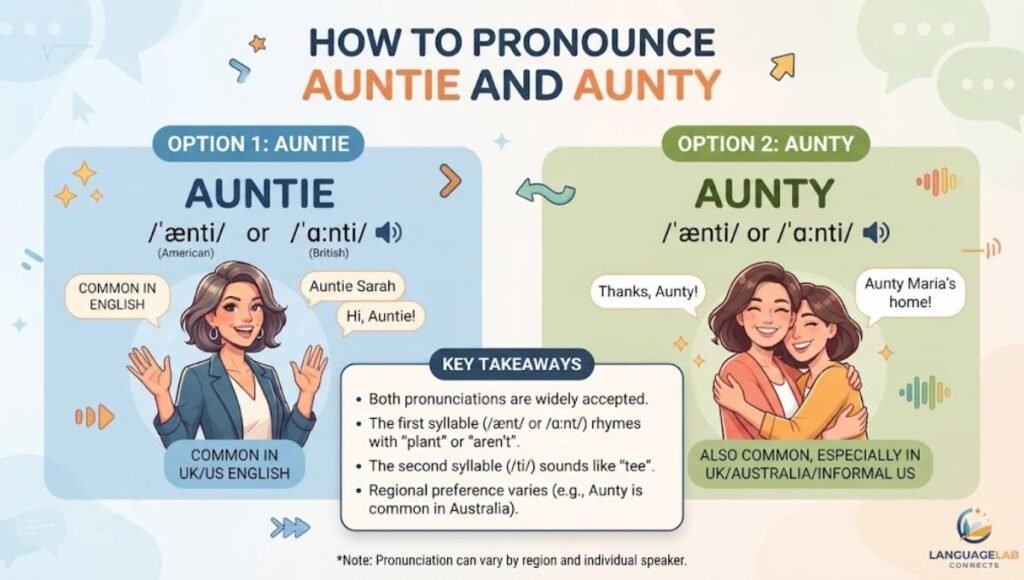
Both spellings are pronounced the same way. In American English, it typically sounds like “AN-tee,” rhyming with “ant.” In British English, it often sounds closer to “AHN-tee,” reflecting the broader British pronunciation of “aunt.” The spelling change between auntie or aunty does not affect how the word is spoken.
Where Auntie and Aunty Come From
Both spellings derive from the formal noun “aunt,” which entered English through Old French “ante,” tracing back to the Latin “amita,” meaning father’s sister. The informal “-ie” and “-y” endings were added later as diminutive or affectionate suffixes, a common pattern in English for creating warmer, more casual versions of family terms, similar to how “mother” became “mommy” or “mummy” in different regions.
Auntie or Aunty: Comparison Table
| Term | Correct? | Common Region | Example |
| Auntie | Yes | United States | “I love spending time with my auntie.” |
| Aunty | Yes | UK, Australia, South Asia | “Aunty is bringing dessert tonight.” |
How to Use Auntie in a Sentence
Since auntie is widely recognized in American writing, it fits naturally into most everyday and casual contexts.
- Everyday conversation: “My auntie always brings snacks to family gatherings.”
- Children’s writing: “The story is about a girl who visits her auntie every summer.”
- Casual email: “Can’t wait to see you and Auntie Rachel this weekend.”
How to Use Aunty in a Sentence
Aunty fits naturally in British, Australian, and South Asian contexts, and works well in similar informal settings.
- Everyday conversation: “Aunty just called to check if we’re coming for dinner.”
- Respectful address (Australian context): “Aunty Joan shared stories about the local community’s history.”
- Casual writing: “My aunty knows everyone in the neighborhood.”
Common Mistakes With Auntie or Aunty
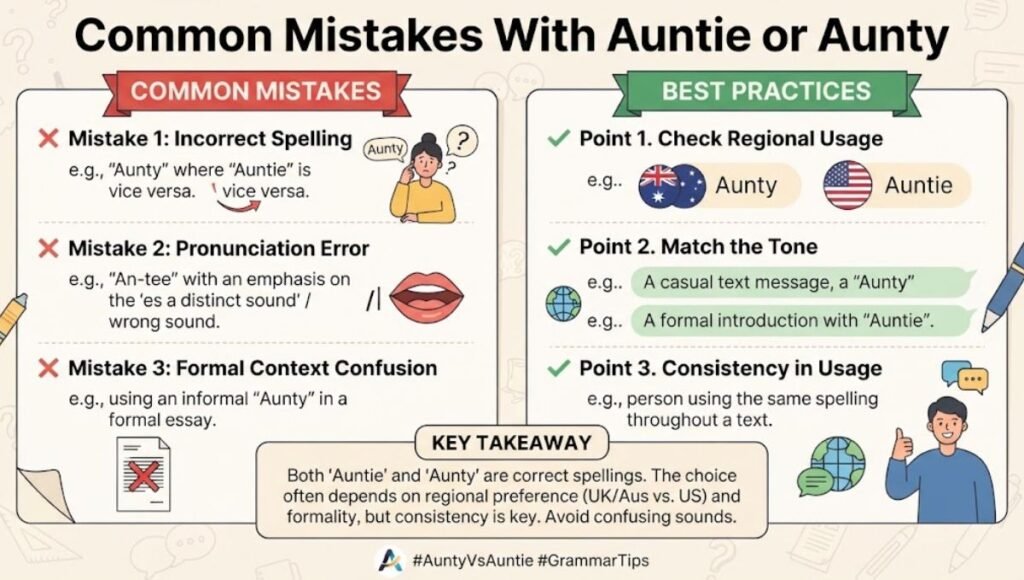
Even though both spellings are valid, a few real mistakes do show up around this word.
Incorrect: “Auntys are coming over.”
Correct: “Aunties are coming over,” or “Aunts are coming over.”
When pluralizing “auntie,” change the “ie” to “ies,” similar to how “cookie” becomes “cookies.”
Incorrect: “Antie is my favorite relative.”
Correct: “Auntie is my favorite relative.”
“Antie” is a common misspelling that drops the necessary “u.”
Incorrect: Switching spellings mid-document without consistency, such as writing “auntie” in one paragraph and “aunty” in the next.
Correct: Pick one spelling and use it consistently throughout a single piece of writing.
Consistency matters more than which specific spelling you choose.
Related Words: Aunt, Aunties, Aunty’s
A few related forms are useful to understand alongside auntie or aunty.
- Aunt (formal, neutral): the standard, formal spelling used in official or neutral writing.
- Aunties (plural): more than one auntie.
- Aunty’s (possessive): belonging to aunty, as in “aunty’s house.”
- Uncle (related term): the male counterpart, with informal variants “unc” or “uncy,” though these are far less standardized.
Which Spelling Should You Choose for Your Writing?
If you are writing for an American audience, auntie is generally the safer default. If your audience is British, Australian, or South Asian, aunty tends to feel more natural and familiar. For global or mixed audiences, either spelling works, as long as you stay consistent throughout the piece. The auntie or aunty choice ultimately comes down to who is reading your content.
FAQs About Auntie or Aunty
Is auntie or aunty correct?
Both are correct. They are accepted spelling variants of the informal word for “aunt,” with regional preference determining which one feels more natural.
Which spelling is more common in American English?
“Auntie” is more commonly used in American English, while “aunty” appears more frequently in British, Australian, and South Asian English.
Is “aunty” used as a respectful title outside the family?
Yes. In Australian English, “Aunty” is used as a respectful title for female Aboriginal and Torres Strait Islander elders. In South Asian communities, “aunty” is also often used broadly for older women, whether or not they are blood relatives.
What is the plural of auntie or aunty?
The plural of “auntie” is “aunties,” and the plural of “aunty” is “aunties” as well, since both drop the “y” or “ie” ending in favor of “-ies.”
Should I use “aunt,” “auntie,” or “aunty” in formal writing?
Use “aunt” in formal or professional writing. Save “auntie” or “aunty” for casual, conversational, or warm, personal contexts.
Conclusion
When it comes to auntie or aunty, there is no wrong choice, only a regional one. Pick auntie for American audiences, aunty for British, Australian, or South Asian readers, and stick with your choice consistently across your writing.










1 thought on “Auntie or Aunty: What’s the Right Word to Use in 2026?”