
Every time you type this word, the same question comes back: is it followup or follow up? That hesitation is completely normal, since the correct spelling depends on grammar, not personal preference. Quick answer: followup or follow up comes down to one simple test, which this guide walks through step by step.
Followup or Follow Up: Which One Is the Verb?
When this word is describing an action, the answer to followup or follow up is always the two-word, unhyphenated form. As a phrasal verb, meaning “to take further action” or “check on something after an earlier step,” it never takes a hyphen, regardless of tense.
- I need to check back with the client tomorrow.
- She reached out again on the invoice last Tuesday.
- We’re taking that next step on your application this week.
The verb changes tense the normal way (present, past, continuous), but the spacing between the two words never changes.
Followup or Follow Up: Which One Is the Noun or Adjective?
The other half of the followup or follow up question involves the hyphenated form. Hyphenated, it works as either a noun or an adjective. As a noun, it names an event or action. As an adjective, it describes another noun.
As a noun: “The doctor scheduled a review for next month.” As an adjective: “This is a reminder email regarding your request.”
A simple test: if a word like “a,” “the,” or “this” sits right in front of it, and it’s naming or describing something rather than doing something, the hyphen belongs.
Why This Word Causes So Much Confusion
Part of what makes this spelling debate so persistent is how English handles compound words in general. Some compounds merge into a single word over time (“email” used to be hyphenated), some stay permanently hyphenated, and some shift spelling entirely based on their role in a sentence.
This particular term happens to change form depending on function, which trips up even confident writers. Autocorrect suggestions and casual internet spelling only add to the uncertainty.
Is the One-Word Spelling Ever Correct?
Generally, no. Major style guides, including AP style, along with authorities like Merriam-Webster and Grammarly, consistently side with the two-word or hyphenated forms, and treat the fused, unspaced spelling as one to avoid in formal or professional writing.
That said, it isn’t rare. You’ll see it in casual texting, some technical documentation or code (variable names, database fields), and informal blog comments. It has no separate meaning of its own. It’s simply a compressed habit rather than a distinct, accepted word.
Grammar Breakdown: Parts of Speech at a Glance
This table settles the spelling question at a glance.
| Spelling | Part of Speech | Example |
| Two words, no hyphen | Verb | “I’ll check back tomorrow.” |
| Hyphenated | Noun | “She scheduled a review.” |
| Hyphenated | Adjective | “This is a reminder question.” |
| One solid word | Nonstandard | Avoid in formal writing |
“With” vs. “On”: A Smaller Related Question
Once the spelling question is settled, people often ask about the preposition that comes next.
Contacting a specific person after sending something usually pairs with “with”: “I’ll check back with the client after sending the proposal.”
Checking the status of a task or situation usually pairs with “on”: “Can you check on the shipping delay?”
Both patterns are correct. The choice depends on whether you’re focused on a person or a task.
More related Post : Choosing or Chosing: 5 Rules for Getting This Spelling Right https://feastinsidar.com/choosing-or-chosing/
Real-Life Examples Across Different Contexts
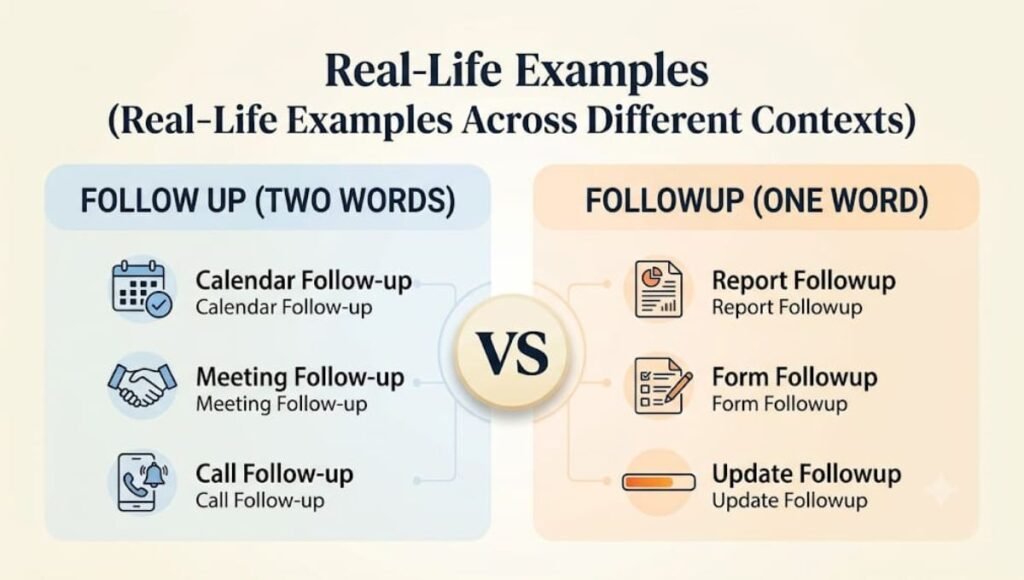
Everyday conversation: “Did you check back with your landlord about the leak?” Workplace email: “Circling back on my message from last week, do you have an update?” Business writing: “Our team will conduct a 30-day review after implementation.” Academic writing: “Researchers scheduled a six-month assessment after the initial treatment.” Casual writing: “Just checking in, lol, did you ever hear back from them?”
Notice that whenever the sentence describes an action, the two-word verb fits. Whenever it names or describes a thing, the hyphenated form fits.
Common Mistakes People Make
The most frequent followup or follow up mistake looks like this:
Incorrect: “I need to follow-up on this tomorrow.” Correct: “I need to follow up on this tomorrow.” This is a verb, so no hyphen belongs, even though the hyphenated shape looks tempting.
The same logic applies any time this word describes an action rather than names one: keep the space, skip the hyphen, and never fuse it into one solid word, no matter how casual the writing is.
American English vs. British English
Good news here: there’s no major regional split. American and British English generally agree on the verb versus noun and adjective distinction, and both discourage the fused spelling in formal writing. Casual one-word usage shows up online regardless of region, reflecting habit rather than an accepted regional standard.
Related Words With the Same Pattern
- Check in (verb) and check-in (noun/adjective)
- Sign up (verb) and sign-up (noun/adjective)
- Set up (verb) and setup (noun), an exception where the solid form actually is standard
- Back up (verb) and backup (noun/adjective), another exception worth knowing
Recognizing this pattern helps with dozens of similar English phrases beyond this one.
A Simple Trick to Remember the Difference
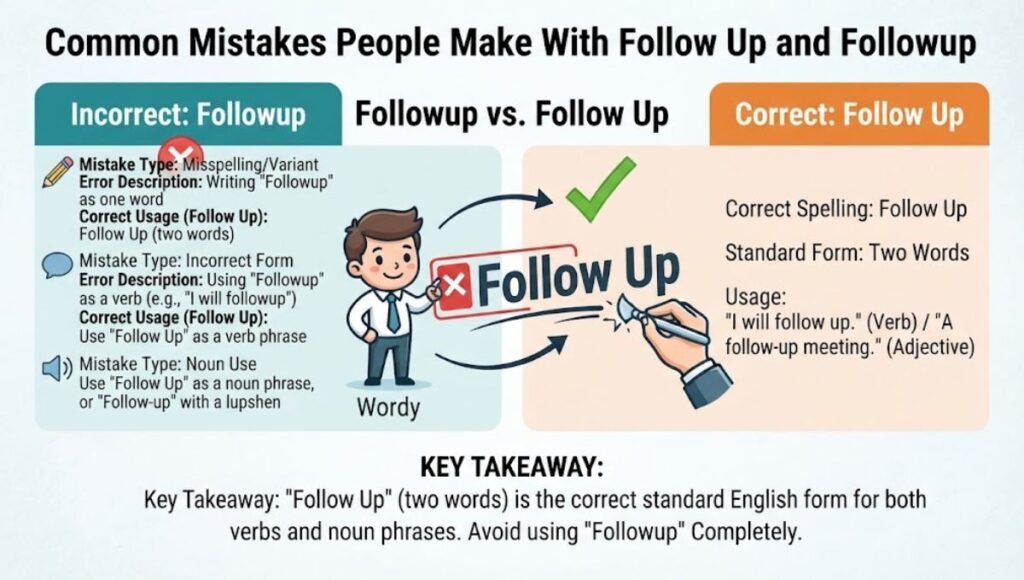
If you can substitute a single verb like “check” or “pursue,” keep the space: the sentence still makes sense.
If you can substitute a single noun like “meeting” or “message,” add the hyphen: the sentence still makes sense.
This quick substitution test settles nearly every real situation you’ll run into.
Frequently Asked Questions
Followup or follow up: which is correct in a formal email?
In a formal email, use the two-word verb for an action (“I will check back”) or the hyphenated form for a noun or adjective (“a reminder email”).
Is the hyphenated version correct?
Yes, when it functions as a noun or adjective, such as “a review call” or “send a reminder.”
Is the solid, one-word version a real word?
No, not in standard English. It’s a nonstandard spelling, and most style guides recommend avoiding it.
How do I know which form to use in a sentence?
Ask whether the word is doing an action (use the two-word verb) or naming or describing something (use the hyphenated form).
Can I use the one-word spelling in casual writing?
You’ll see it used casually, but choosing the standard verb or hyphenated form is a safer choice even in relaxed writing.
Final Answer
So, followup or follow up? There’s no single spelling that’s always correct, because the meaning depends on the sentence. Use the two-word verb for an action, hyphenate it for a noun or adjective, and skip the solid one-word form altogether in anything you want to look polished.