You typed the word, stared at it, and something looked off. Is it verbiage or verbage? You are not imagining the confusion. These two spellings sound almost identical out loud, and one of them shows up constantly in emails, contracts, and casual speech even though most dictionaries reject it. People keep debating verbiage or verbage in comment sections and grammar forums, but the answer is not actually up for debate. The correct spelling is verbiage. Verbage is not a standard English word, and once you know why, you will never second-guess it again.
The Quick Answer: Which One Is Correct?
Verbiage is the correct spelling. It is a noun that refers to wording, phrasing, or the style in which something is written or spoken. It often carries a negative connotation, describing language that is wordy, dense, or harder to read than it needs to be.
Verbage is a misspelling. It shows up often in speech and informal writing, but no major dictionary lists it as a standard entry. If you are choosing between verbiage or verbage for a document, a resume, or a business email, always go with verbiage.
What Does Verbiage Actually Mean?
Verbiage means the specific words, phrasing, or tone used in a piece of writing or speech. It can describe:
- The wording of a contract, policy, or legal document
- The general style of someone’s writing
- An excess of words that adds little meaning
Here is a simple example: “The verbiage in this insurance policy is so dense that I had to read it three times.” That sentence uses verbiage to describe wordy, hard-to-follow language, which is the word’s most common usage.
Verbiage can also be neutral. A marketing manager might ask, “Can you tighten up the verbiage on this landing page?” In that case, verbiage simply means the text or wording, without implying that it is excessive.
Is Verbage a Real Word?
No. Verbage is not recognized as a standard word by Merriam-Webster, the Oxford English Dictionary, or any other major reference. It is widely believed to be a mishearing or misspelling of verbiage, likely influenced by how the correct word sounds when spoken quickly.
Some language commentators have noted that a small number of writers use verbage informally to mean roughly the same thing as verbiage, but this usage has never been adopted by dictionaries or style guides. If you are debating verbiage or verbage for anything you plan to publish, submit, or send professionally, verbiage is the only safe choice.
Verbiage vs Verbage: Key Dicfferences at a Glance
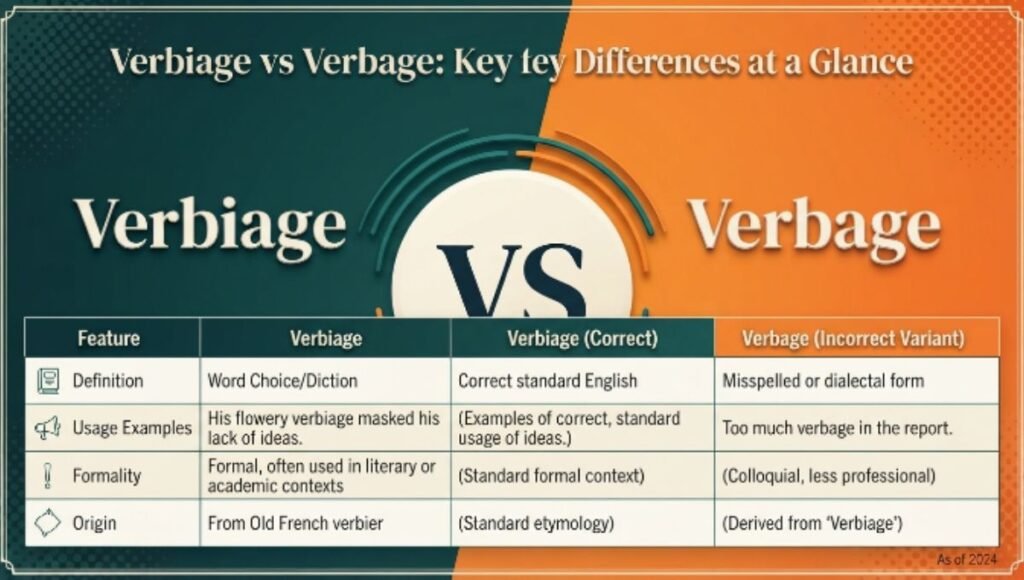
| Term | Correct? | Meaning | Where You’ll See It |
| Verbiage | Yes | Wording, phrasing, or style of language; often implies excess | Dictionaries, formal writing, business documents |
| Verbage | No | Nonstandard spelling, sometimes used informally for the same idea | Casual speech, typos, some spoken usage |
Where Does the Word Verbiage Come From?
Verbiage comes from the French word “verbiage,” which itself traces back to the Old French “verbe,” meaning “word.” That in turn descends from the Latin “verbum,” also meaning “word.” The word entered English in the 18th century and originally carried a fairly negative meaning: wordy or padded language that added little value.
Over time, the meaning softened. While verbiage still often implies wordiness, it is now commonly used in a neutral sense simply to mean “the text” or “the wording,” especially in American business and marketing contexts.
Verbage has no comparable history. It does not appear in etymological records as a legitimate variant, which supports the conclusion that it developed later as an error rather than as a parallel spelling. Some language observers have speculated that verbage grew out of a casual blend of “verbiage” and “garbage,” which would explain why it often shows up in contexts describing language that feels cluttered or excessive. That theory is not confirmed by any dictionary, but it does capture how the word tends to be used when people reach for it by mistake.
More related Post: Choosing or Chosing: 5 Rules for Getting This Spelling Right https://feastinsidar.com/choosing-or-chosing/
How Do You Pronounce Verbiage?
Verbiage is pronounced VUR-bee-ij, with three syllables. The middle syllable is often clipped in fast, casual speech, which can make it sound closer to “ver-bij.” That clipped pronunciation is likely a major reason people write verbage instead of verbiage. Once you say the full three syllables slowly a few times, the correct spelling becomes much easier to remember.
Grammar Rules: Noun Form, Plural, and Related Words
Verbiage is a noncount noun in most everyday usage, similar to words like “information” or “advice.” This means:
- You do not usually say “verbiages” as a plural.
- You do not typically use “a verbiage” with an article in standard usage.
- You use it the way you would use “wording” or “language” in a sentence.
There is no separate adjective or verb form of verbiage. If you need an adjective, you would typically say “wordy,” “verbose,” or “long-winded” instead.
Verbiage is used in both American and British English, but it appears more frequently in American business and marketing writing, where it often just means “the copy” or “the text.” British writers are somewhat more likely to reserve verbiage for its older, more critical sense of padded or unnecessary language. In either case, the spelling itself does not change between American and British English. Verbage is never correct in either variety.
How to Use Verbiage Correctly in a Sentence
Use verbiage when you are talking about the specific words or phrasing in a piece of writing, especially when that phrasing feels excessive, technical, or hard to parse. A few natural patterns:
- “The verbiage needs to be simplified before we send this to clients.”
- “I appreciate the verbiage in your closing paragraph.”
- “Legal teams often add verbiage that slows down the reading experience.”
Avoid pairing verbiage with words like “excess” or “excessive,” since the word already implies wordiness on its own. “Excess verbiage” is technically redundant, though you will still see it used casually.
Real-Life Examples of Verbiage in Everyday Writing
Workplace email: “Can we revise the verbiage in the onboarding guide? New hires are getting confused.”
Academic writing: “The professor asked the student to reduce the verbiage in her thesis introduction.”
Business writing: “Our legal team reviewed the verbiage in the vendor agreement before signing.”
Casual conversation: “Honestly, the verbiage on that cereal box is more complicated than it needs to be.”
Formal writing: “The committee objected to the verbiage in section four, calling it unnecessarily dense.”
Each of these sentences works because verbiage refers to wording or phrasing, not to a single word or a short phrase. It describes a stretch of text, not an isolated term.
Common Mistakes People Make With Verbiage and Verbage
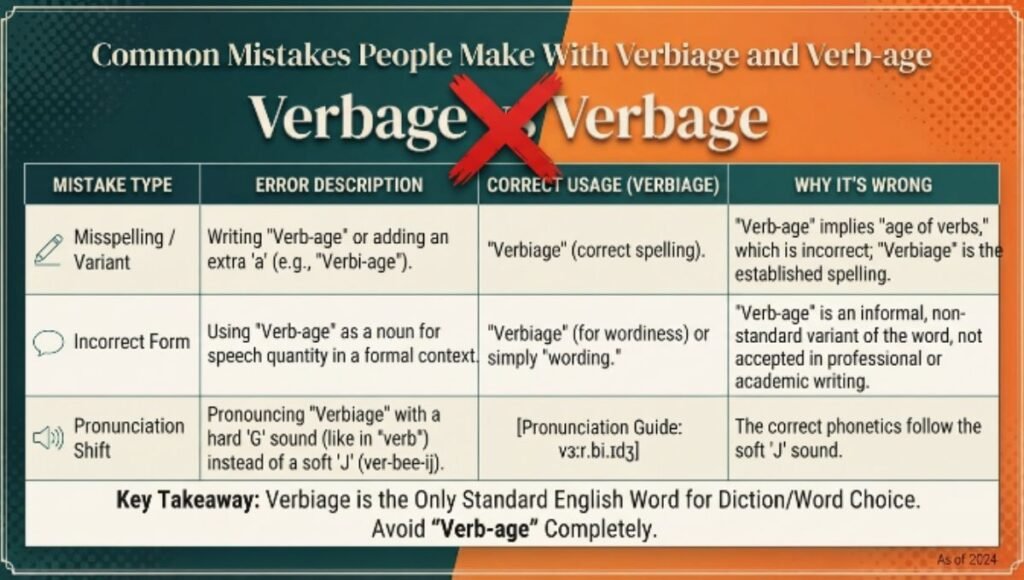
Incorrect: The verbage on this form is confusing. Correct: The verbiage on this form is confusing. This mistake usually happens because verbiage is often mispronounced without its middle syllable, so the written form drifts to match the spoken shortcut.
Incorrect: Can you write the verbage for the new website? Correct: Can you write the verbiage for the new website? Even in informal requests, verbiage is the word professionals expect to see in writing.
Incorrect: There is a lot of excess verbiage in this contract. Correct: There is a lot of verbiage in this contract. Since verbiage already suggests excess, adding “excess” in front of it is redundant rather than wrong.
None of these slips are unusual. Verbiage is one of the more commonly misspelled words in professional English, largely because of how it sounds when spoken.
Related Words You Can Use Instead
If verbiage feels overused in your writing, consider these alternatives depending on context:
- Wording, for a neutral description of language choice
- Phrasing, for how a sentence or idea is structured
- Verbosity, for excessive or padded language
- Diction, for word choice in formal or literary writing
- Jargon, when the wording is overly technical
Quick Tips to Remember the Correct Spelling
A simple memory trick: verbiage contains the letter “i,” just like the word “write.” Verbage does not contain that “i,” which is a useful signal that it is the incorrect form. If you picture yourself writing verbiage, the “i” is right there to remind you.
FAQs
Is verbage a word?
No. Verbage is not recognized in standard dictionaries. Verbiage is the correct and only accepted spelling.
What does verbiage mean in simple terms?
Verbiage means the specific wording or phrasing used in writing or speech, often implying that the language is more complex or wordy than necessary.
How do you use verbiage in a sentence?
You can write, “Please simplify the verbiage in this email before sending it,” using verbiage to refer to the wording as a whole.
Is verbiage always negative?
Not always. Verbiage often implies excess wording, but in many business and marketing contexts, it is used neutrally to mean “the text” or “the copy.”
Why do people write verbage instead of verbiage?
Verbiage is often pronounced without its middle syllable, which makes it sound similar to verbage. That mispronunciation is the most likely reason the misspelling persists.
Conclusion
When you are stuck choosing between verbiage or verbage, remember that only one of them belongs in a dictionary. Verbiage is correct, verbage is not, and the easiest way to lock this in is to remember that verbiage contains the same “i” as the word “write.” Use that small detail as your anchor, and you will spell it correctly every time.










1 thought on “Verbiage or Verbage: The 1 Correct Spelling and 7 Ways to Use It Right”