Typed “that’s to bad” in a text and had a flicker of doubt before hitting send? This is one of the most common small mistakes in English, and it happens to careful writers all the time. Here’s the direct answer to the to bad or too bad question: “too bad” is correct when expressing sympathy or disappointment. “To bad” is a grammatical error in that context, since “to” simply isn’t the right word before an adjective like “bad” used this way.
To Bad or Too Bad: Which One Is Correct? (Quick Answer)
“Too bad” is the correct phrase for expressing that something is unfortunate or regrettable, as in “It’s too bad you couldn’t make it.” “To bad” is not a standard expression with this meaning; “to” is a preposition or infinitive marker, and it doesn’t function as an intensifier the way “too” does.
Why Do People Confuse “To” and “Too”?
The to bad or too bad mix-up happens because “to” and “too” are pronounced identically. Since English relies so heavily on spelling to distinguish meaning, it’s easy for the extra “o” in “too” to get dropped, especially when typing quickly or texting.
“To” is also the far more common word of the two, appearing constantly as a preposition (“go to the store”) or before a verb (“want to leave”). That higher frequency makes it the default choice for a lot of writers, even in places where “too” is actually required.
What Does “Too Bad” Mean?
“Too bad” is an idiomatic expression meaning that something is unfortunate, regrettable, or disappointing. It can express genuine sympathy or, depending on tone, a more dismissive “that’s unfortunate, but nothing can be done” attitude.
- “It’s too bad the concert got canceled.” (genuine sympathy)
- “Too bad, you should have arrived on time.” (dismissive tone)
The meaning shifts slightly based on context and delivery, but the spelling stays the same either way.
More related Post : Naive or Nieve? 6 Facts That Settle This Spelling Confusion https://feastinsidar.com/naive-or-nieve/
Is “To Bad” Ever Grammatically Correct?
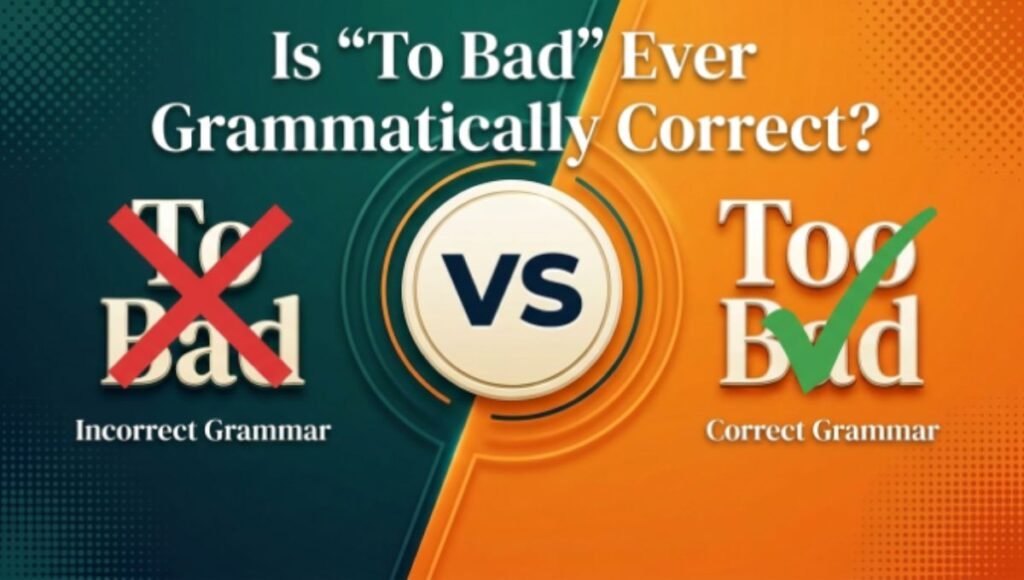
Not as a standalone expression meaning “unfortunate.” However, “to” can legitimately appear right before the word “bad” in a completely different grammatical structure, where “to” functions as a preposition connecting a verb or adjective to what follows: “This exposure is harmful to bad actors online.” In that sentence, “to bad actors” simply means “toward bad actors,” which is an entirely different use of “to” than the intensifying “too” in the idiom.
So when comparing to bad or too bad, only “too bad” works as the fixed expression, but “to” can still show up next to “bad” in other, unrelated sentence structures.
To vs Too vs Two: A Quick Grammar Refresher
| Word | Function | Example |
| To | Preposition or infinitive marker | I’m going to the store. / I want to leave. |
| Too | Adverb meaning “also” or “excessively” | She’s coming too. / It’s too hot outside. |
| Two | Number | I have two dogs. |
“Too bad” uses the second sense of “too,” the one meaning “excessively” or, in this idiom, simply intensifying “bad” into a fixed phrase about misfortune.
Origin of “Too Bad” as an Expression
“Too bad” developed as a shortened, idiomatic way of saying something is “too bad to be acceptable” or “too unfortunate to ignore.” Over time, English speakers dropped the rest of the sentence and kept just “too bad” as a standalone expression, which is common in how idioms form and settle into everyday speech.
Pronunciation of “Too” and “Bad”
“Too” is pronounced /tuː/, with a long “oo” sound, identical to “to” and “two.” “Bad” is pronounced /bæd/, with a short vowel sound. Since “to” and “too” sound exactly the same, pronunciation offers no clue for spelling, which is exactly why the to bad or too bad mistake is so easy to make in writing, even for confident speakers.
To Bad vs Too Bad: Side-by-Side Comparison
| Phrase | Correct in This Context? | Reason |
| Too bad | Yes | “Too” functions as an intensifier, forming the idiom meaning “unfortunate” |
| To bad | No | “To” is a preposition or infinitive marker and doesn’t intensify adjectives this way |
This table settles the to bad or too bad question clearly. If you’re expressing sympathy or disappointment, “too bad” is the only correct option.
How to Use “Too Bad” Correctly in a Sentence
- Everyday conversation: “Too bad you missed the game, it was a great one.”
- Workplace communication: “It’s too bad the vendor couldn’t meet our deadline.”
- Email: “Too bad we couldn’t connect this week. Let’s find time next Monday.”
- Casual writing: “Too bad, so sad, right?”
- Formal writing: “It is unfortunate, though perhaps too predictable, that the merger fell through.”
Notice the last example avoids the idiom entirely in favor of more formal language, which is a useful option when “too bad” feels too casual for the setting.
Common Mistakes With “To” and “Too”
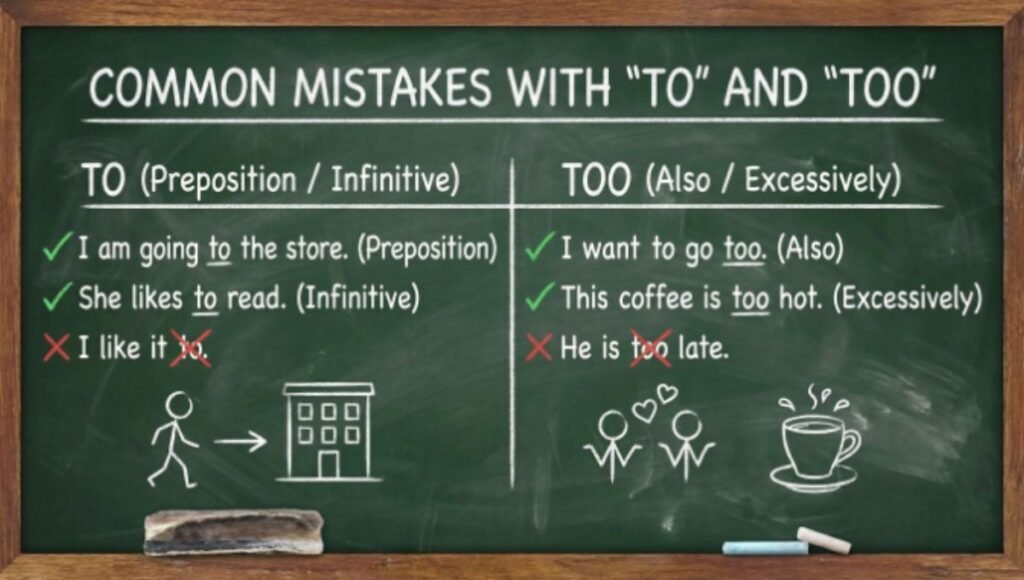
Incorrect: That’s to bad, I was really looking forward to it. Correct: That’s too bad, I was really looking forward to it. This is the classic to bad or too bad typo, caused by dropping the extra “o” in “too.”
Incorrect: I wanted too go to the party, but I couldn’t. Correct: I wanted to go to the party, but I couldn’t. Here the mistake runs the other way: “to” belongs before the verb “go,” not “too.”
Incorrect: It’s not to bad outside today. Correct: It’s not too bad outside today. Even in casual phrases downplaying something, “too” is still required before “bad.”
Related Words and Terms
Words and phrases related to “too bad” include “unfortunate,” “a shame,” “regrettable,” and “what a pity,” all of which can substitute for the idiom in more formal writing. Related grammar terms worth knowing include “homophone” (words that sound alike but differ in spelling and meaning), which describes the entire “to,” “too,” and “two” family.
Frequently Asked Questions
Is “to bad” ever correct?
Not as an expression meaning “unfortunate.” “To” can appear before “bad” in other sentence structures, but the fixed idiom always uses “too bad.”
What does “too bad” mean?
It means something is unfortunate or regrettable, and depending on tone, it can express either genuine sympathy or mild dismissiveness.
How do I remember the difference between “to” and “too”?
A simple trick: if you can replace the word with “also” or “excessively” and the sentence still makes sense, use “too.” Otherwise, use “to.”
Is “too bad” formal or informal?
It leans informal or conversational. In formal writing, consider alternatives like “unfortunate” or “regrettable” instead.
Why do “to” and “too” get mixed up so often?
Because they’re pronounced exactly the same way, so spelling is the only thing that separates them, and that’s easy to overlook while typing quickly.
Conclusion
The to bad or too bad debate comes down to one simple fix: add the extra “o” whenever you mean “unfortunate,” “also,” or “excessively.” Once that small habit sticks, this common typo becomes one you’ll never have to think twice about again.