Ordered something with a kick and then couldn’t remember if it’s “spicey” or “spicy” when texting a friend about it? This mix-up trips up more people than you’d expect. Here’s the direct answer to the spicey or spicy question: “spicy” is the correct spelling, and “spicey” is a common misspelling with no accepted use in standard English.
Spicey or Spicy: Which One Is Correct? (Quick Answer)
“Spicy” is the only correct spelling for describing food, flavor, or anything with a strong, hot, or pungent quality. “Spicey” does not appear in standard American or British dictionaries and isn’t considered an acceptable variant, no matter how natural it might look with the extra “e.”
Why Do People Misspell “Spicy” as “Spicey”?
The spicey or spicy confusion happens because English has plenty of words that do keep an “e” before adding “-y,” like “spacey” and “homey.” Since those words follow a slightly different pattern, it’s easy to assume “spice” should work the same way.
It doesn’t. “Spicy” follows the more common and more consistent spelling rule, which drops the silent “e” from “spice” before adding the “-y” ending. The exceptions you might be thinking of are just that: exceptions, not the standard pattern.
What Does “Spicy” Mean?
“Spicy” is an adjective describing food or flavors that have a hot, sharp, or pungent taste, usually from ingredients like chili peppers, pepper, or strong spices. It can also be used figuratively to describe something exciting, scandalous, or provocative.
- “This curry is way too spicy for me.” (literal, describing heat)
- “That was a spicy comment to make in a meeting.” (figurative, describing boldness)
Both uses are common in everyday American English, and neither one changes the correct spelling.
Is “Spicey” Ever an Acceptable Spelling?
No. Unlike some words that have two legitimate spellings depending on context, “spicey” has no accepted alternate use. It’s simply a spelling error, and dictionaries, style guides, and standard usage all agree that “spicy” is the only correct form for describing heat, flavor, or boldness.
The Spelling Rule: Dropping the Silent “E”
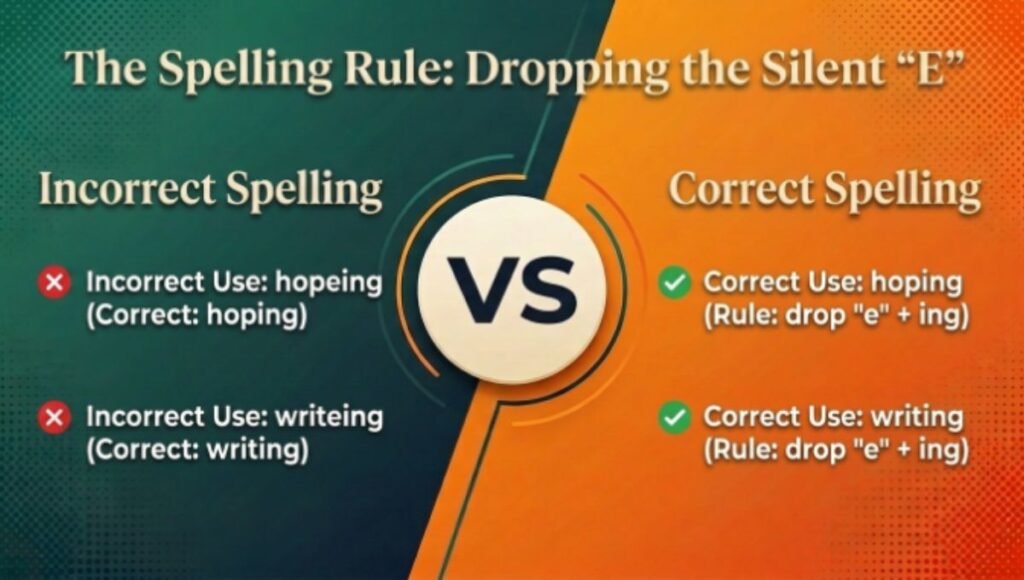
Here’s the grammar rule behind the spicey or spicy answer: when a word ends in a silent “e” and you add the suffix “-y,” English usually drops that final “e” before attaching the suffix. This is why “ice” becomes “icy,” “spice” becomes “spicy,” and “nose” becomes “nosy.”
Some words break this pattern for pronunciation reasons, which is where words like “spacey” and “homey” come from; they keep the “e” specifically so the word doesn’t get misread. “Spice” doesn’t have that same pronunciation problem, so it follows the standard rule and drops the “e.”
Grammar and Part of Speech: “Spicy”
“Spicy” functions as an adjective. It modifies nouns directly (“spicy sauce”) or follows a linking verb (“this soup tastes spicy”). Like most short adjectives, it forms its comparative and superlative by changing the “y” to “i” and adding “-er” or “-est,” rather than using “more” or “most.”
More related Post : Unphased or Unfazed? 6 Facts That Settle the Spelling Debate https://feastinsidar.com/outie-meaning/
Comparative and Superlative Forms: Spicier, Spiciest
| Form | Word | Example |
| Base | spicy | This salsa is spicy. |
| Comparative | spicier | This salsa is spicier than the last one. |
| Superlative | spiciest | This is the spiciest salsa on the menu. |
Notice that the “y” changes to “i” before adding “-er” or “-est,” which is standard for adjectives ending in a consonant plus “y.” “Spiciest” and “spicier” are correct; “spicyer” and “spicyest” are not.
Pronunciation of “Spicy”
“Spicy” is pronounced /ˈspaɪsi/, with the stress on the first syllable and a long “i” sound, like the word “spice” itself with a “y” added at the end. The pronunciation doesn’t hint at a hidden “e,” which is part of why the misspelling “spicey” feels intuitive even though it’s incorrect.
Spicey vs Spicy: Side-by-Side Comparison
| Term | Correct? | Reason |
| Spicy | Yes | Standard spelling formed by dropping the silent “e” in “spice” before adding “-y” |
| Spicey | No | Not recognized in standard dictionaries; a common misspelling |
This comparison settles the spicey or spicy debate clearly: only one spelling is standard, and the other one, while common in casual typing, isn’t accepted in formal or professional writing.
How to Use “Spicy” Correctly in a Sentence
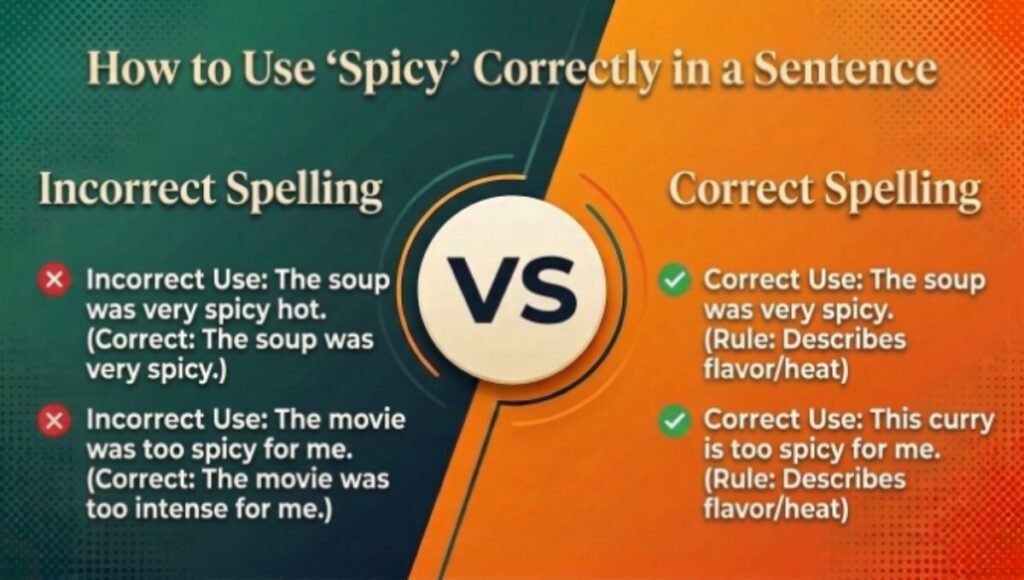
- Everyday conversation: “Can you make it less spicy next time?”
- Workplace communication: “The feedback in that email was a little spicy, don’t you think?”
- Academic writing: “Capsaicin is the compound responsible for the spicy sensation in chili peppers.”
- Email: “I ordered the spicy version by mistake, but it turned out great.”
- Casual writing: “This playlist has some spicy tracks I think you’ll love.”
Each of these sentences uses “spicy” naturally, whether describing literal heat or a figurative sense of boldness.
Common Mistakes With “Spicy” and “Spicey”
Incorrect: This sauce is way too spicey for me. Correct: This sauce is way too spicy for me. Dropping the “e” before “-y” is the standard rule for words like “spice,” so “spicy” is always correct here.
Incorrect: That was a spicyer take than I expected. Correct: That was a spicier take than I expected. When forming the comparative, change the “y” to “i” before adding “-er,” rather than just adding “-er” to the base spelling.
Incorrect: She likes spicey food more than I do. Correct: She likes spicy food more than I do. Even in casual texting or social media, “spicey” is still considered a misspelling, not an accepted informal variant.
Related Words and Terms
Words related to “spicy” include “hot,” “peppery,” and “fiery” as rough synonyms for describing intense flavor, along with “mild” and “bland” as opposites. Grammatically similar words that also drop a silent “e” before “-y” include “icy,” “lacy,” and “hazy,” which follow the exact same spelling pattern as “spicy.”
Frequently Asked Questions
Is “spicey” a real word?
No. “Spicey” is not recognized in standard dictionaries and is considered a common misspelling of “spicy.”
Why does “spicy” drop the “e” from “spice”?
English typically drops a silent “e” before adding the suffix “-y,” which is why “spice” becomes “spicy” rather than “spicey.”
What is the comparative form of “spicy”?
The comparative form is “spicier,” formed by changing the “y” to “i” and adding “-er.”
Can “spicy” describe something other than food?
Yes. “Spicy” can also describe something bold, exciting, or scandalous, like a spicy comment or a spicy plot twist.
Is “spicey” ever correct in British English?
No. Both American and British English use “spicy” as the standard spelling, with no regional variation.
Conclusion
The spicey or spicy debate has a clear, simple answer: “spicy” is correct every time, and “spicey” is a misspelling worth dropping from your writing for good. Remember the rule behind it (drop the silent “e” before adding “-y”) and you’ll spell it correctly without having to think twice again.