You’re writing a sentence, and both “put” and “keep” seem like they could work, but something tells you they’re not actually interchangeable. That instinct is correct. Understanding the put and keep differences comes down to one core idea: “put” describes a single action of placing something, while “keep” describes an ongoing state of holding or maintaining something.
Put and Keep Differences: The Quick Answer
“Put” means to move or place something into a position, while “keep” means to hold, retain, or maintain something over time.
“Put” is about the moment something is placed somewhere. “Keep” is about what happens afterward, whether that’s continuing to hold an object, maintain a habit, or preserve a condition. Once you separate the “moment” from the “duration,” the put and keep differences become much easier to apply.
Why “Put” and “Keep” Get Confused
Both words can appear in similar sentences, like “put it in the drawer” and “keep it in the drawer,” which makes them feel interchangeable. They aren’t. “Put” focuses on the act of placing something, while “keep” focuses on the state of it remaining there afterward. English learners often mix them up because both involve an object staying somewhere, even though the emphasis is completely different.
What Does “Put” Mean?
“Put” is an irregular verb meaning to move something into a specific position, state, or condition. It describes a single, often quick action.
Example: “She put the book on the shelf.” This sentence focuses on the moment the book was placed there, not on what happens to it afterward.
What Does “Keep” Mean?
“Keep” is also an irregular verb, but it means to hold onto, retain, maintain, or continue something over a period of time. It emphasizes duration rather than a single moment.
Example: “She keeps the book on the shelf.” This sentence focuses on the book’s ongoing location or condition, not the act of placing it there.
More related Post : 5 Facts That Settle the Nosey or Nosy Debate for Good https://feastinsidar.com/nosey-or-nosy/
Grammar Breakdown: Verb Forms of Put and Keep

Both verbs are irregular, but they behave differently across tenses, which adds another layer to the put and keep differences.
“Put” stays the same in every tense: put, put, put (present, past, past participle). “Keep” changes form: keep, kept, kept. This means “keep” follows a more familiar irregular pattern, while “put” is unusual because its spelling never changes at all.
Put and Keep Differences: Comparison Table
| Word | Meaning | Focus | Example |
| put | To place or move something into position | A single action or moment | He put his keys on the counter. |
| keep | To hold, retain, or maintain something | An ongoing state or duration | He keeps his keys on the counter. |
“Put” vs “Keep” in Real Sentences
Everyday conversation: “Put your shoes by the door” asks for a one-time action, while “Keep your shoes by the door” asks for an ongoing habit.
Workplace communication: “Put the file in the shared folder” describes a single task, while “Keep the file in the shared folder” describes where it should stay long term.
Academic writing: “The researchers put the samples in a controlled environment” describes the action taken, while “The researchers kept the samples in a controlled environment” describes the duration of that condition.
Email: “I’ll put the notes in the report” refers to a one-time addition, while “I’ll keep you updated” refers to an ongoing process.
Formal writing: “The company put new policies in place” marks the moment of implementation, while “The company keeps its policies under regular review” marks a continuing practice.
Common Phrases: Put Away vs Keep Away
“Put away” means to place something in its proper storage spot, usually as a single action, as in “Put away your toys before dinner.” “Keep away” means to maintain distance from something, often as an ongoing instruction, as in “Keep away from the wet paint.” These phrases highlight the put and keep differences clearly, since one is about storage and the other is about distance over time.
Common Phrases: Put On vs Keep On
“Put on” means to place something onto your body or a surface, typically describing a single action, as in “Put on your jacket before you leave.” “Keep on” means to continue doing something without stopping, as in “Keep on practicing until it feels natural.” Even though both phrases share the same root verbs, their meanings point in very different directions.
Pronunciation of Put and Keep
“Put” is pronounced /pʊt/, rhyming with “foot.” “Keep” is pronounced /kiːp/, rhyming with “sleep.” The two words sound nothing alike, so pronunciation is rarely the source of confusion here. The mix-up is almost always about meaning and usage, not sound.
Common Mistakes With Put and Keep
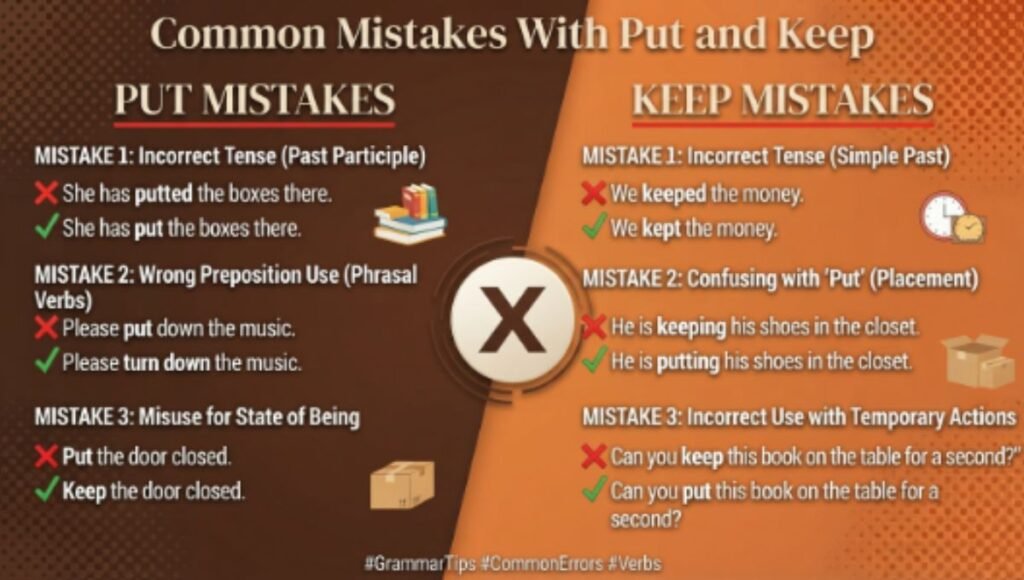
Incorrect: Keep the letter on the desk right now. Correct: Put the letter on the desk right now. Since this describes a one-time action happening immediately, “put” is the right choice rather than “keep.”
Incorrect: I put my passport in a safe place, and it’s still there years later. Correct: I keep my passport in a safe place, and it’s still there years later. Because the sentence describes an ongoing arrangement over years, “keep” fits better than “put,” which only describes the original placement.
Incorrect: Please keep your bag on the chair before you go. Correct: Please put your bag on the chair before you go. This instruction refers to a single upcoming action, so “put” is correct instead of “keep.”
Related Words and Expressions
Several related words and phrases connect to this comparison:
- Place (a close synonym for “put” in the literal sense)
- Store (related to the storage sense of “put away”)
- Maintain (a close synonym for “keep” in formal writing)
- Retain (a more formal synonym for “keep”)
- Hold onto (an informal alternative to “keep”)
Practical Tips for Choosing Between Put and Keep
Ask yourself one question: is this about a single action or an ongoing state? If you’re describing the moment something is placed somewhere, choose “put.” If you’re describing something continuing to exist in a certain place, condition, or habit, choose “keep.” This simple test resolves most put and keep differences without needing to memorize long lists of rules.
Frequently Asked Questions
What is the main difference between put and keep?
The main difference is that “put” describes a single action of placing something, while “keep” describes an ongoing state of holding, maintaining, or retaining something.
Can “put” and “keep” ever be used interchangeably?
Rarely, and only in casual speech where the exact nuance doesn’t matter much. In precise writing, they carry different meanings and should not be swapped freely.
Is “keep” an irregular verb?
Yes. “Keep” changes to “kept” in both the past tense and past participle, unlike “put,” which stays the same across all tenses.
How do I use “put” and “keep” correctly in a sentence?
Use “put” for the moment something is placed somewhere, such as “I put the mail on the table,” and use “keep” for how it remains afterward, such as “I keep the mail on the table.”
Why does English have both “put” and “keep” if they seem similar?
They exist because English separates the idea of a single action from the idea of duration, and “put” and “keep” each specialize in one of those two functions.
Conclusion
Once you understand the put and keep differences, choosing between them becomes almost automatic: use “put” for a single moment of placement, and use “keep” for anything that continues over time. Keep that one distinction in mind, and the rest of the confusion tends to disappear.











1 thought on “6 Key Put and Keep Differences Every English Learner Should”