
You write “level,” add “ing,” and then stop: one L or two? So, levelling or leveling? Both are correct. Leveling (one L) is standard American English, and levelling (two Ls) is standard British English. The split comes from a spelling rule the two countries apply differently. Wondering about levelling or leveling for your own writing? Pick by audience, then stay consistent.
The Quick Answer
Levelling or leveling: which is correct? Both are correct, but they belong to different regions. Use leveling in American English and levelling in British English. Canadian and Australian writers generally follow the British double-L pattern.
The meaning, pronunciation, and grammar are identical. Only the spelling changes.
What Does Leveling Mean?
“Level” works as a noun, an adjective, and a verb. “Leveling” is the present participle (the -ing form) of the verb, and it can also act as a noun.
The verb has several common meanings:
- Make flat or even: “We spent the weekend leveling the backyard.”
- Make equal: “The new rules are leveling the playing field.”
- Knock down: “The storm leveled two barns.”
- Advance a stage: “She is leveling up her character in the game.”
- Speak honestly: “Thanks for leveling with me.”
Related phrases include “level off” and “level out,” which describe something that stops rising or falling.
American vs British Spelling
Neither spelling is a typo. Choosing between levelling or leveling is a matter of regional style, much like color and colour.
| Form | Region | Correct? | Example |
| leveling | United States | Yes | We are leveling the floor today. |
| levelling | UK, Australia, and most Commonwealth English | Yes | They are levelling the ground today. |
The same split affects the past tense. Americans write leveled, and British writers write levelled.
The Doubling Rule Explained
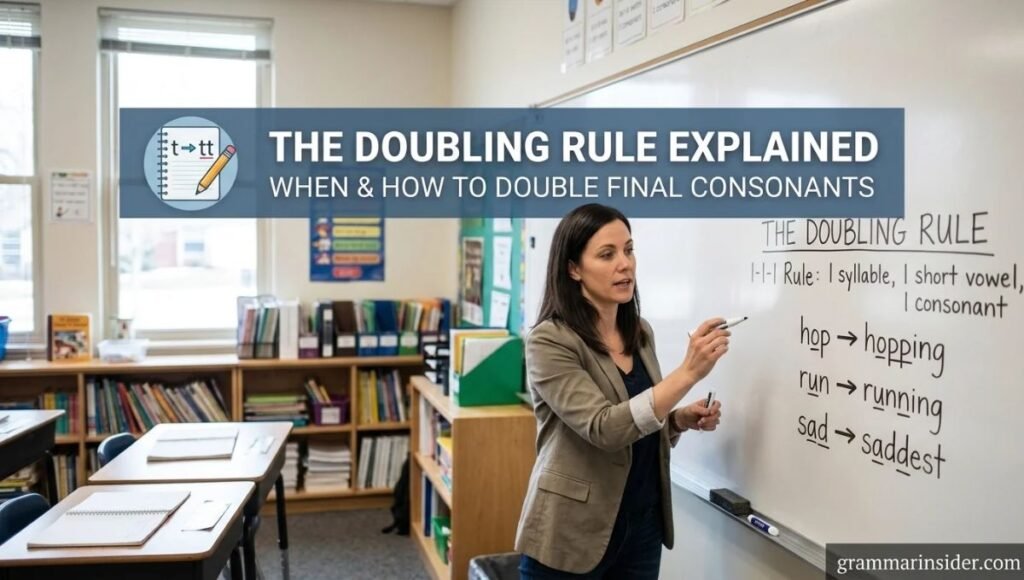
The difference comes down to one rule. British English doubles a final L before adding -ing or -ed, even when the last syllable is unstressed. American English doubles the final consonant only when the last syllable is stressed.
In “level,” the stress falls on the first syllable (LEV-el). The final syllable is unstressed, so American English keeps a single L. British English doubles it anyway.
Compare it with “control,” where the stress falls on the last syllable (con-TROL). Both countries write “controlling.” That is the whole logic behind levelling or leveling.
Verb Forms and Related Words
Your choice in levelling or leveling carries across every form of the verb:
| Form | American | British |
| Base verb | level | level |
| Third person | levels | levels |
| Past tense | leveled | levelled |
| -ing form | leveling | levelling |
| Person who levels | leveler | leveller |
The base word and the “-s” form never change. Only forms that add a suffix starting with a vowel are affected.
Related terms include “level-headed,” “level best,” and “on the level.” The Levellers, a political movement in 17th century England, are always written with a double L because it is a proper name.
Where the Word Comes From
“Level” came into English through Old French (spelled “livel”), which traces back to the Latin “libella.” That Latin word meant a small balance or a leveling instrument, and it comes from “libra,” meaning scales or balance.
The extra L in British spelling has nothing to do with this history. It is a spelling convention. American dictionary makers, led by Noah Webster in the early 1800s, helped popularize simpler spellings, which is why Americans drop the doubled letter.
How to Pronounce It
Both spellings sound the same: LEV-ul-ing, with three syllables and the stress on the first.
The second L is visual only. It does not lengthen the vowel or change the sound.
Levelling or Leveling in Sentences
Here is how each spelling looks in everyday use:
- Everyday (US): “We’re leveling the yard before the party.”
- Everyday (UK): “We’re levelling the garden before the party.”
- Workplace (US): “The new pay bands are leveling salary gaps across teams.”
- Email (US): “Thanks for leveling with me about the delay.”
- Academic (UK): “The policy aims at levelling opportunity across regions.”
- Casual (US): “I spent all night leveling up my character.”
“Leveling with someone” is an idiom meaning to speak honestly. It works the same way in British English, only with the double L: “levelling with someone.”
More Terms: Excel or Excell? 7 Real Examples That Settle the Spelling for Good https://feastinsidar.com/excel-or-excell/
Common Mistakes
The most common slip in levelling or leveling is mixing both in one document. It happens to everyone, especially when editing across regions.
Incorrect: The crew leveled the lot, and the levelling took two days.
Correct: The crew leveled the lot, and the leveling took two days.
Pick one spelling and use it for every form.
Incorrect: “Levelling” is a typo.
Correct: “Levelling” is the British spelling.
It is not an error, just a regional variant.
Other Words With the Same Pattern
Levelling or leveling is not a special case. Many verbs ending in a single L follow the same split.
| American | British |
| traveling | travelling |
| labeled | labelled |
| modeling | modelling |
| counselor | counsellor |
| jeweler | jeweller |
Words stressed on the last syllable, such as “controlling,” “patrolling,” and “propelling,” keep the double L in both versions. A few words run the other way: Americans write “fulfill,” “enroll,” and “installment,” while British writers write “fulfil,” “enrol,” and “instalment.”
Which Spelling Should You Use?
Choose based on your audience, not personal taste.
- US readers or publications: Use leveling.
- UK, Australian, or most Commonwealth readers: Use levelling.
- Style guides: AP and Chicago follow American spelling. UK publishers typically follow British spelling.
- Software: Set your spell-checker to English (US) or English (UK) so it catches inconsistencies.
When deciding between levelling or leveling, check the publication’s style guide first. If none exists, choose one version and keep it throughout.
FAQ
Levelling or leveling: which is correct?
Both are correct. Leveling is the American spelling, and levelling is the British spelling.
Is levelling a misspelling in American English?
No. Americans will recognize it as the British variant. In US writing, however, standard style guides prefer leveling.
Is it leveled or levelled?
It follows the same rule. Use leveled in American English and levelled in British English.
How do you use leveling in a sentence?
Use it like any -ing verb form. For example: “The crew is leveling the ground before the concrete arrives.”
The Bottom Line on Spelling
Levelling or leveling? Use leveling for American readers and levelling for British ones, and keep your choice consistent.








1 thought on “Levelling or Leveling? The 1-Letter Difference That Matters (2026)”