
You want to say someone does a job brilliantly, then you stop at the end of the word: one l or two? The extra l feels natural because related words like “excellent” have two. Here is the answer to Excel or Excell: excel is the only correct spelling for the verb. Stay with this guide for examples that make Excel or Excell an easy choice.
Excel or Excell: The Short Answer
“Excel” is the correct spelling. “Excell” is a misspelling. The verb has one l: e-x-c-e-l.
The second l only appears when you add an ending, as in “excelled” and “excelling.” It also appears in related words like “excellent” and “excellence.”
The rest of this guide explains the meaning, the double l rule, and quick ways to remember it.
What Does Excel Mean?
To excel means to do something exceptionally well or to be better than others. It is a verb, and it usually pairs with “at” or “in.”
Both prepositions are standard. “Excel at” often points to a skill or task (“excel at public speaking”). “Excel in” often points to a subject or field (“excel in biology”).
Examples:
- “She excels at solving complex problems.”
- “He wants to excel in his career.”
Why Excell Is Wrong
The extra l is easy to add. English has many words ending in “ell,” such as “sell,” “spell,” and “tell,” so the pattern looks familiar. Related words like “excellent” and “excellence” also have two l’s, which pulls the eye toward “excell.”
But the verb base has only one l. That is why Excel or Excell is really a question about the base form versus the longer related words.
Does “excell” have any legitimate use? Not in standard English. You might see it in a business name or a username, but that is a creative stylization, not correct spelling.
Excel or Excell at a Glance
| Form | Correct? | Meaning | Use |
| excel | Yes | To do something exceptionally well | Verb base: “I want to excel.” |
| excels | Yes | Third person singular | “She excels at math.” |
| excelled | Yes | Past tense | “He excelled in school.” |
| excelling | Yes | Present participle | “They are excelling at work.” |
| Excel (capital E) | Yes | Microsoft’s spreadsheet program | Brand name, always capitalized |
| excell | No | None | Replace with “excel” |
| exceled, exceling | No | None | Use “excelled,” “excelling” |
Excelled and Excelling: The Double L Rule
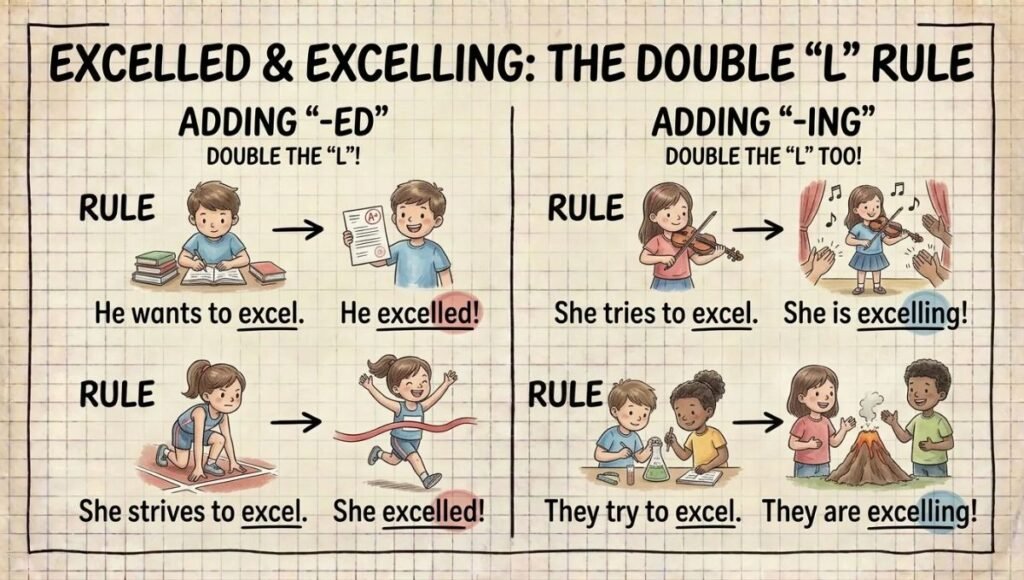
When a verb ends in a single vowel plus a single consonant, and the stress falls on the last syllable, you double the consonant before -ed or -ing. Excel follows this pattern, since the stress is on the second syllable: ex-CEL.
That gives excelled and excelling, not “exceled” or “exceling.”
Other verbs follow the same rule: compel becomes compelled, repel becomes repelled, and refer becomes referred. The base form and the -s form stay short: excel and excels.
There is no American versus British split here. Both use “excelled” and “excelling” because the stress falls on the last syllable. This differs from “travel,” where American English writes “traveled” and British English writes “travelled.” So the choice between Excel or Excell never depends on your region.
Excel the Verb vs Excel the Program
“Excel” with a capital E is also the name of Microsoft’s spreadsheet program. It is a proper noun, so it is always capitalized: “I track our budget in Excel.”
The verb is lowercase unless it starts a sentence: “She excels at Excel.” Both spellings use one l.
That sentence shows why the confusion survives. People see the program name daily, then see the verb in a different context. When you ask Excel or Excell in either case, the answer is the same: one l.
Origin and Pronunciation
“Excel” comes from the Latin verb “excellere,” meaning “to rise above” or “to surpass.” The related words “excellent” and “excellence” come from the same Latin source, which explains their double l.
Pronounce it ik-SEL, with the stress on the second syllable. “Excelled” sounds like ik-SELD, and “excelling” sounds like ik-SEL-ing.
“Excellent” has a different rhythm: EK-suh-lunt, with the stress on the first syllable. That shift in stress is one reason the spelling looks different.
More related Terms: Gluing or Glueing? 3 Quick Rules to Spell It Right Every Time https://feastinsidar.com/gluing-or-glueing/
Excel in Real Sentences
Here are seven examples of Excel or Excell in real contexts, all using the correct form.
Everyday: “My daughter excels at drawing.”
Casual: “He totally excelled at karaoke last night.”
Workplace: “She excels at managing tight deadlines.”
Email: “Thank you for the update. Your team continues to excel under pressure.”
Academic: “Students who excel in math often choose engineering.”
Business: “To excel in sales, you need to listen first.”
Formal: “The award recognizes employees who excel in service to the community.”
In the email example, “continues to excel” uses the base form because it follows “to.” In the casual example, “excelled” doubles the l because it is past tense.
Common Mistakes
Almost everyone has made one of these slips. Here is how Excel or Excell mistakes usually look.
Incorrect: She will excell in her new role.
Correct: She will excel in her new role.
The base verb has one l.
Incorrect: He exceled at chess.
Correct: He excelled at chess.
The stress is on the last syllable, so the l doubles before -ed.
Incorrect: Please open the excell file.
Correct: Please open the Excel file.
The program name has one l and a capital E.
Related Words and Terms
These related words may help in your writing:
- Related words: excellent, excellence, excellency, excelsior (Latin for “higher”)
- Synonyms: surpass, outdo, shine, thrive, stand out, outperform
- Antonyms: fail, struggle, lag behind, underperform
- Common phrases: excel at, excel in, strive for excellence, excellent work
- Program terms: Microsoft Excel, Excel spreadsheet, Excel formulas
Notice that “excellent” and “excellence” keep both l’s, while the verb base keeps one.
Easy Ways to Remember It
A few tricks make Excel or Excell automatic:
- One l for the base verb. Add the second l only for “excelled” and “excelling.“
- Match it to similar verbs. Compel, compelled. Repel, repelled. Excel, excelled.
- Save the double l for “excellent.” The adjective and noun get two, but the verb stays short.
- Picture the program name. You have seen “Excel” with one l on countless spreadsheets.
FAQs
Is Excel or Excell the correct spelling?
Excel. “Excell” is not a standard spelling.
What does excel mean?
It means to do something exceptionally well or to be better than others, as in “She excels at math.”
Is it “excel at” or “excel in”?
Both are standard. “Excel at” often points to a skill, and “excel in” often points to a field or subject.
How do you spell the past tense of excel?
Excelled, with two l’s: “He excelled in school.”
The Takeaway
In the Excel or Excell choice, the winner is excel, with one l. Add the second l only for “excelled” and “excelling,” and remember that Microsoft Excel keeps its single l too.








2 thoughts on “Excel or Excell? 7 Real Examples That Settle the Spelling for Good”