Fueled vs fuelled: which one should you write? Both look right, and both show up in print, which makes the choice feel like a trap. Here is the quick answer. Fueled is the standard American spelling, and fuelled is the standard British spelling. They mean exactly the same thing. Below, you will learn why fueled vs fuelled differ, plus simple rules for choosing the right form.
Fueled vs Fuelled: Which Spelling Is Correct?
Both spellings are correct. Use fueled (one l) in American English. Use fuelled (two l’s) in British English and in most other varieties that follow British spelling.
Neither one is a mistake, and neither has a different meaning. The only question is which spelling matches your audience. If you are writing for a US reader, choose fueled. If your publisher or readers use British spelling, choose fuelled. Then stay consistent in the whole document.
What Does Fueled Mean?
Fueled is the past tense and past participle of the verb fuel. The verb has two main meanings:
- To supply something with fuel: “She fueled the truck before the long drive.”
- To make something stronger or more intense: “The new report fueled the debate.”
The second meaning is very common in news and business writing. When something “fuels” growth, anger, or speculation, it gives that thing more energy to continue. Fuelled carries the same two meanings in British English.
What Is the Difference Between Fueled and Fuelled?
There is no difference in meaning, pronunciation, or grammar. The difference is regional spelling. Here is fueled vs fuelled at a glance, along with the matching forms:
| Form | American English | British English | Meaning |
| Past tense | fueled | fuelled | Supplied with fuel or intensified |
| Past participle | fueled | fuelled | Same as above |
| Present participle | fueling | fuelling | Supplying fuel or intensifying |
| Base form | fuel | fuel | Same in both |
| Third person | fuels | fuels | Same in both |
Does either spelling have a legitimate use that the other lacks? No. Fueled is not an error in a British context, and fuelled is not an error in an American one, but each looks foreign in the other region. American editors will usually change fuelled to fueled, and British editors will usually do the reverse.
Why Does American English Use One L and British English Use Two?
The reason behind fueled vs fuelled is a spelling rule about doubling final consonants before endings like -ed and -ing.
American English doubles the final consonant only when the stress falls on the last syllable. That is why “begin” becomes “beginning” and “refer” becomes “referred.” The word “fuel” is stressed on its first syllable (FYOO-uhl), so American English does not double the l: fueled and fueling.
British English follows a different pattern for words ending in l. It doubles the l after a single vowel no matter where the stress falls. So fuel becomes fuelled and fuelling, just as “travel” becomes “travelled.”
The two systems are consistent inside themselves. If you learn the rule once, you can predict the spelling of many other verbs.
How Do You Pronounce Fueled and Fuelled?
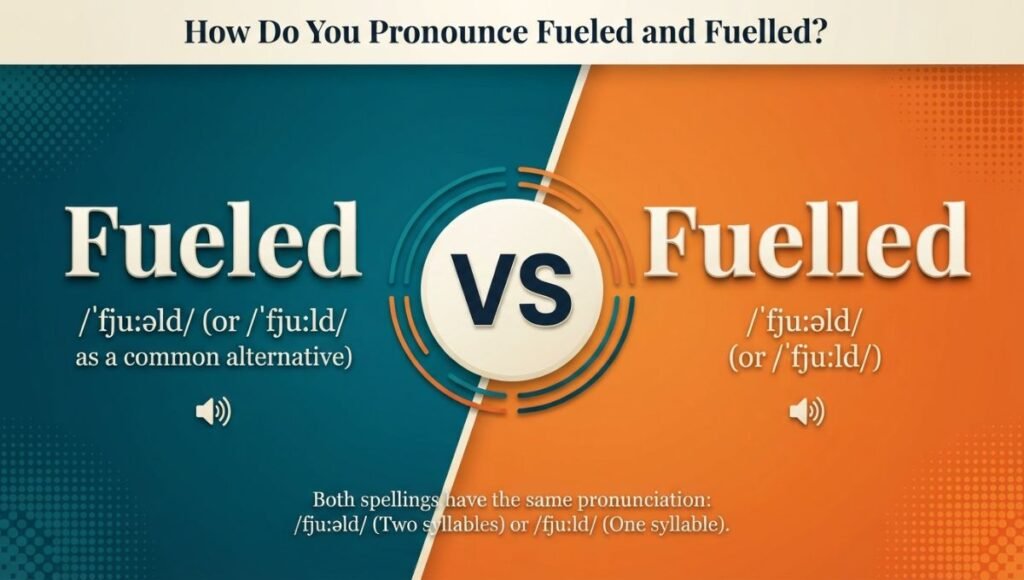
Both spellings sound identical: FYOO-uhld (/ˈfjuːəld/). The extra l in fuelled does not change the sound, and no one pronounces it differently in speech.
The same is true for the -ing forms. Fueling and fuelling are both said as FYOO-uh-ling. This is why the confusion appears only in writing and never in conversation.
What Are the Verb Forms of Fuel?
Fuel works as both a noun and a verb. Here are its forms:
- Noun: fuel (plural: fuels), as in “The rocket used liquid fuel.”
- Base verb: fuel, as in “Coffee will fuel my morning.”
- Third person: fuels, as in “Demand fuels prices.”
- Past tense and past participle: fueled (US) or fuelled (UK)
- Present participle: fueling (US) or fuelling (UK)
Prefixes follow the same spelling pattern. “Refuel” becomes refueled and refueling in American English, and refuelled and refuelling in British English.
You will also see the word inside compound adjectives, such as “caffeine-fueled,” “jet-fueled,” and “solar-fueled.” British writers write these as “caffeine-fuelled” and so on.
More related Post: Prioritize vs Prioritise: 2 Spellings, 1 Meaning, and a 3-Step Rule https://feastinsidar.com/prioritize-vs-prioritise/
Where Does the Word Fuel Come From?
Fuel came into English through Old French, and its roots go back to the Latin word focus, which meant “hearth” or “fireplace.” That origin makes sense: the earliest fuel was what people burned to keep a fire going.
Over time, the word broadened. It came to mean anything that feeds a fire or an engine, and later anything that feeds a feeling or a trend. That is the source of figurative uses such as “fueling speculation.”
The doubled l in fuelled is not an older form of the word. It comes from the British spelling convention for verbs that end in l, not from the Latin root.
How Do You Use Fueled and Fuelled in a Sentence?
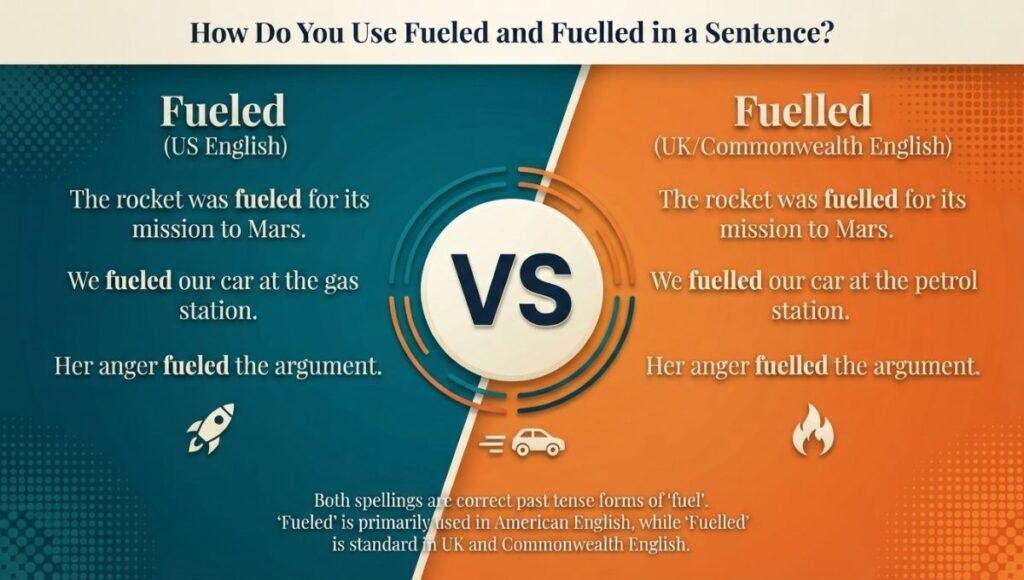
Here are natural examples in different contexts:
- Everyday conversation: “We fueled up at the last gas station before the mountains.”
- Casual writing: “We stayed up all night, fueled by pizza and bad jokes.”
- Workplace: “Strong holiday sales fueled our growth this quarter.”
- Email: “The delay was fueled by supply shortages, so we expect normal shipping by Friday.”
- Academic writing: “The author argues that cheap credit fueled the housing boom.”
- British writing: “The strike was fuelled by anger over pay cuts.”
Why is “fueled” correct in the academic example? Because it is the past tense of “fuel,” used here in its figurative sense of “made stronger.” In the British example, “fuelled” is correct because the sentence follows UK spelling.
What Are the Most Common Mistakes With Fueled and Fuelled?
These errors are common, and they are simple to fix. Anyone who has stopped to check fueled vs fuelled is in good company, because both forms look natural.
Mistake 1: Mixing spellings in one document
Inconsistent: The airline refueled its jets and fuelled expansion.
Consistent: The airline refueled its jets and fueled expansion.
Choose one spelling system and apply it to every form of the word.
Mistake 2: Mixing the -ed and -ing spellings
Inconsistent: The rumors fueled the debate, and the fuelling of anger continued.
Consistent: The rumors fueled the debate, and the fueling of anger continued.
If you use fueled, use fueling. If you use fuelled, use fuelling.
Mistake 3: Using the base form for the past tense
Incorrect: The news fuel the argument yesterday.
Correct: The news fueled the argument yesterday.
Regular past tense verbs need an ending, so add -ed or -led as your spelling system requires.
Mistake 4: Misspelling the word
Incorrect: fuled or fuelded
Correct: fueled (US) or fuelled (UK)
Keep the “e” before the “l,” and add only the ending you need.
Mistake 5: Using British spelling for a US audience
Less suitable: The company’s fuelling costs rose sharply.
Better: The company’s fueling costs rose sharply.
Fuelling is not wrong, but American readers and style guides expect fueling.
Which Other Words Follow the Same Spelling Pattern?
Fuel is not the only verb that behaves this way. Many verbs ending in a single l follow the same American and British split:
| American English | British English |
| traveled, traveling | travelled, travelling |
| canceled, canceling | cancelled, cancelling |
| labeled, labeling | labelled, labelling |
| modeled, modeling | modelled, modelling |
| signaled, signaling | signalled, signalling |
| counseled, counseling | counselled, counselling |
Note that American English also has a version with two l’s for some of these words in certain uses, so check a current dictionary or style guide if you are unsure. You can also find synonyms of fuel in figurative use, such as stoke, feed, drive, power, and boost. The opposite ideas include dampen and quell.
Common phrases with this word include fuel up, fuel the fire, add fuel to the fire, fuel economy, fuel gauge, and fueled by. In each phrase, the spelling of fueled or fuelled follows your regional style.
How Can You Remember Fueled vs Fuelled?
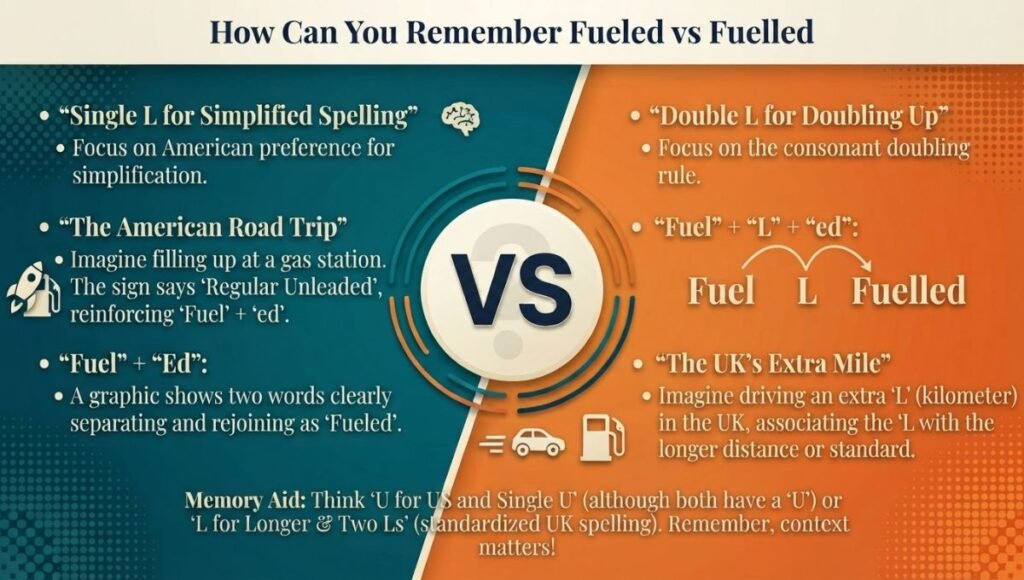
Here are some simple memory tricks:
- Think “shorter is American.” American English tends to use fewer letters, so fueled (one l) is the US spelling.
- Link it to travel. If you write “traveled” in the US and “travelled” in the UK, use the same pattern for fueled and fuelled.
- Match your audience. Writing for American readers means fueled and fueling. Writing for British, Australian, or many other readers means fuelled and fuelling.
- Check before you publish. Search your document for “fuell” and “fuel” plus “ed” to catch any mismatched spellings.
Frequently Asked Questions About Fueled and Fuelled
Is fueled vs fuelled a difference in meaning?
No. It is only a difference in spelling. Both words mean the same thing and sound the same.
Is fuelled wrong in American English?
It is not wrong, but it reads as British. Most American publications and editors prefer fueled.
Which is correct: fueling or fuelling?
Both are correct. Fueling is the American spelling, and fuelling is the British spelling.
Do Canadian and Australian writers use fueled or fuelled?
Australian writers generally use fuelled, following the British pattern. Canadian usage also often leans toward fuelled, but style guides differ, so check the one your publication follows.
Which Spelling Should You Use?
The fueled vs fuelled question has a simple answer: both spellings are correct, and both mean the same thing. Use fueled and fueling for American English. Use fuelled and fuelling for British English.