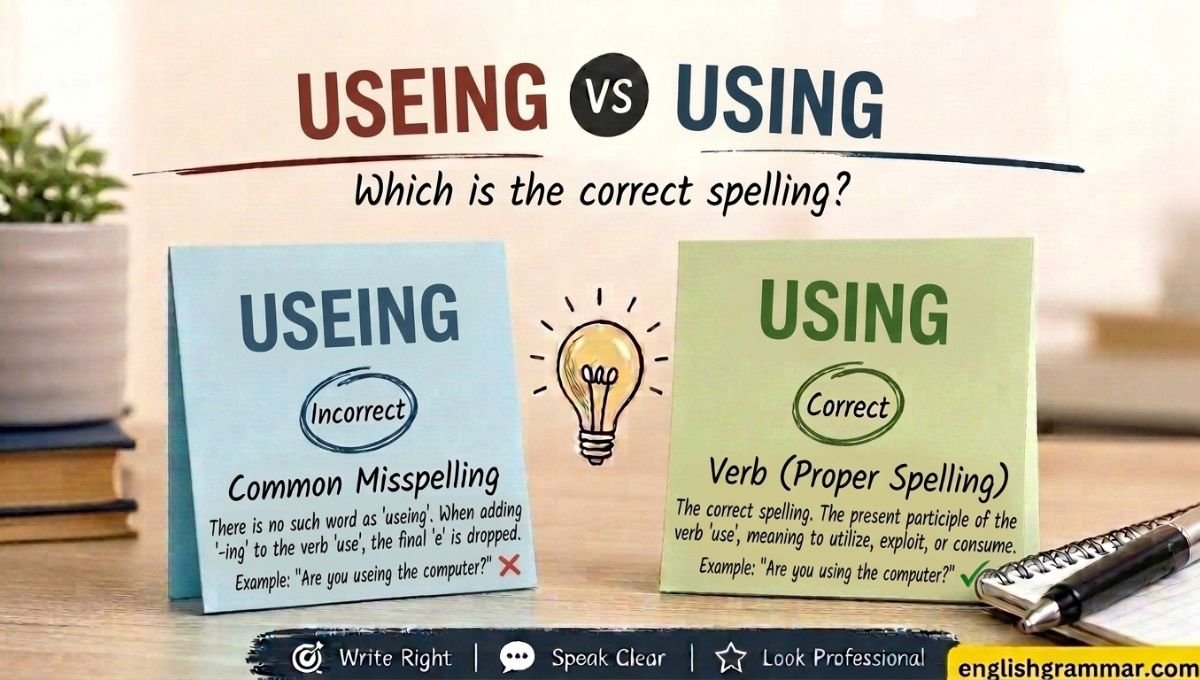
Useing or Using: which one is right? The confusion makes sense, because “use” ends in E and most endings seem to attach directly to the base word. But the correct spelling is using, with no E before -ing, and “useing” is a misspelling. This guide explains the rule behind Useing or Using so you can spell it correctly without hesitation.
Quick Answer: Which Spelling Is Correct?
The correct spelling is “using.” “Useing” is not a word in standard English.
Using is the present participle of the verb “use.” To form it, you drop the silent E from “use” and add -ing. If you are stuck on Useing or Using in a draft, delete the E and keep the rest.
That covers the main question. The sections below explain the rule, the exceptions, and a few quick ways to remember it.
What Does Using Mean?
Using is the -ing form of the verb use, which means to employ something for a purpose. It appears in several common patterns.
- Ongoing action: “She is using the new software.”
- As a gerund (a verb acting like a noun): “Using a checklist saves time.”
- As a participle that describes how something is done: “Using a ruler, he drew a straight line.”
In every case, using keeps the same meaning as use. Only the grammar job changes.
Useing vs Using at a Glance
In the Useing or Using question, only one form has a dictionary entry. This table also includes a few related forms.
| Term | Correct? | Meaning | Use |
| Using | Yes | Present participle or gerund of “use” | Ongoing actions and noun phrases |
| Useing | No | Not an English word | Treat as a typo |
| Used | Yes | Past tense of “use” | Completed actions |
| Usable | Yes | Able to be used | Adjective, the more common spelling |
| Useable | Variant | Same meaning as usable | Accepted variant, less common |
Does “useing” have any legitimate use? No. You would only keep it when quoting a misspelling or when a person or brand has chosen it as a deliberate name.
Why Does Use Lose Its E?
The answer is a standard spelling rule. When a word ends in a silent E, drop the E before adding a suffix that begins with a vowel. The ending -ing begins with I, which is a vowel, so the E goes.
- make + ing = making
- write + ing = writing
- hope + ing = hoping
- create + ing = creating
- use + ing = using
That is the whole reason behind Useing or Using. The silent E in “use” helps the U sound long, but once -ing is added, the I does that job. The pattern U, S, I still points to a long U sound, the same way it does in “music.”
Dropping the E also avoids an awkward run of letters. “Useing” has three vowels in a row, which English tends to avoid.
Why Do People Write Useing?
Writers usually type “useing” because they picture the base word first and then add the ending. Your brain sees “use” and attaches “-ing” like a label, forgetting the drop-the-E rule.
Some words confuse the pattern. A few words keep their E before -ing, so the rule can feel unreliable. We cover those exceptions below.
The Useing or Using slip is common in fast typing and in texting. Spell check flags it immediately, and most people only make the mistake occasionally.
Using Grammar: Verb Forms and Pronunciation
Use works as both a verb and a noun, and the two sound different.
- Verb: use (pronounced yooz)
- Third person singular: uses (“He uses a standing desk.”)
- Past tense and past participle: used (“We used a template.”)
- Present participle and gerund: using (pronounced YOO-zing)
- Noun: use (pronounced yoos, as in “a good use of time”)
- Person noun: user
- Related noun: usage
Using is pronounced the same way in American and British English, and the spelling is identical. When you are thinking about Useing or Using in a sentence, remember that the verb sounds like “yooz,” so the -ing form is “YOO-zing.”
One more form deserves a note: “used to,” as in “I used to live there,” is pronounced yoost to. It is a separate pattern and does not change how using is spelled.
More related Terms: Buoy or Bouy? The 1 Letter Order That Stops the Mix-Up https://feastinsidar.com/buoy-or-bouy/
Where Does Use Come From?
Use traces back to the Latin verb uti, meaning to use, and reached English through Old French (user). The word has been part of English for many centuries.
Many related words come from the same Latin root, including usage, utility, and useful. This history explains why the word family is so large, but it does not change the -ing spelling rule.
There is no biblical or classical story behind the spelling, so the Latin root is the part that matters.
Using in Real Sentences
When Useing or Using appears in your own writing, these sentences show the correct choice in different settings.
Everyday conversation
- “I’m using my sister’s laptop until mine gets fixed.”
Workplace communication
- “We are using the shared drive for all project files.”
- “Thanks for sending the draft. I’m using your notes to finish the summary.”
Academic writing
- “Using a control group, the researchers compared the results.”
Business writing
- “Using customer feedback, the team redesigned the checkout page.”
Casual writing
- “Still using the same phone case from three years ago.”
In the academic and business examples, “using” opens the sentence as a participle phrase. It describes how the action was done. The subject that follows should be the one doing the using, which keeps the sentence clear.
Common Spelling Mistakes
The Useing or Using slip shows up in a few predictable ways, and each one is easy to fix.
Incorrect: We are useing a new tool.
Correct: We are using a new tool.
Drop the silent E before -ing.
Incorrect: She used to be usin the old system.
Correct: She used to be using the old system.
Keep the full -ing ending, including the G.
Incorrect: Is this file useable?
Correct: Is this file usable?
Both spellings appear, but “usable” is the more common choice.
Which Words Keep the E Before -ing?
The drop-the-E rule covers most verbs, and Useing or Using falls on the dropping side. A few verbs keep their E, and the reasons are usually clear.
- Words ending in double E: see + ing = seeing, agree + ing = agreeing, free + ing = freeing
- The verb “be”: be + ing = being
- Words that would be confused with another word: dye + ing = dyeing (not “dying”), singe + ing = singeing (not “singing”)
- Words ending in -oe: hoe + ing = hoeing, canoe + ing = canoeing
The word “age” is a special case. American English usually writes aging, while British English often uses ageing, though both spellings are accepted in many contexts.
None of these exceptions applies to “use.” Its E is silent, and it drops away.
Easy Ways to Remember Using
Here are three tricks to settle Useing or Using for good.
- Use the family. Making, writing, hoping, and using all follow the same pattern. If you can spell making, you can spell using.
- Say the sound. The word is YOO-zing. There is no sound for a separate E, so the spelling has no extra E.
- Check the vowels. If you see three vowels in a row in “useing” (u, e, i), that is a signal to remove one. The silent E is the one that goes.
If you still hesitate, type it and let spell check confirm it. It will flag “useing” immediately.
FAQs About Using
Is “useing” ever correct?
No. “Useing” is not a standard English word. The correct spelling is using. Keep “useing” only when quoting a misspelling or using a name on purpose.
Why do you drop the E in using?
Because “use” ends in a silent E, and -ing starts with a vowel. English drops the silent E before a vowel ending, as in making, writing, and hoping.
What is the past tense of use?
The past tense is used. For example: “We used the old template last year.”
Is it “usable” or “useable”?
Both appear in dictionaries, but usable is the more common spelling. Choose usable unless a style guide tells you otherwise.
How do you use using in a sentence?
Place it where an ongoing action or a method is described: “Using a timer helps me stay focused.”
The Spelling to Remember
The answer to Useing or Using is simple: using is correct, and “useing” is not a word. Drop the silent E before -ing, just as you do in making and writing, and you will spell it correctly every time.







1 thought on “Useing or Using? The 1 Silent E Rule and 3 Tricks to Remember It”