
You are signing off an email and your fingers hesitate: trully or truly? The extra “l” looks right because words like “really” and “finally” have double l’s. Here is the quick fix: truly is the correct spelling, and “trully” is a misspelling. Whenever you doubt trully or truly, remember that true drops its e and adds only “ly.”
Truly or Trully: The Quick Answer
“Truly” is the correct spelling. It is an adverb meaning “genuinely” or “in a true way.” “Trully” is a misspelling, and “truely” is also incorrect.
Correct: “I truly appreciate your help.”
Incorrect: “I trully appreciate your help.”
The correct form has one l in the middle and no e before the ending.
Why Is Trully Wrong?
English has a reliable pattern: when an adjective ends in l and you add -ly, you get a double l. Real becomes really, final becomes finally, and usual becomes usually.
“Trully” borrows that pattern, and that is why it looks right. But true ends in e, not l. The correct move is to drop the e and add -ly, which gives truly with a single l.
The mix-up in trully or truly comes from a pattern that is real but does not apply here. Does “trully” have any legitimate use? No. Dictionaries list only truly.
What Does Truly Mean?
Truly is an adverb. It has several related meanings:
- Genuinely or accurately: “She truly believes it.”
- Very (as an intensifier): “It was a truly wonderful day.”
- Sincerely: “I am truly sorry.”
- In fact: “Truly, I had no idea.”
As an adverb, it has no plural and no verb forms. It is pronounced TROO-lee, with two syllables. Related words include the adjective true and the noun truth.
Why Does True Lose Its E?
Usually, a silent e stays when you add -ly: sure becomes surely, complete becomes completely, and late becomes lately.
True is an exception. The e disappears, and true becomes truly. The e is the real issue behind trully or truly, so it helps to learn the small group of words that behave the same way:
- true becomes truly
- due becomes duly
- whole becomes wholly
The same e-dropping happens before other endings: nine becomes ninth, and argue becomes argument. Treat these as a short list to memorize.
More Terms: Cueing or Cuing? Which Spelling Is Correct? (5 Easy Tips) https://feastinsidar.com/cueing-or-cuing/
Truly, Trully, and Truely at a Glance
Here is trully or truly beside the other common error, “truely”:
| Form | Correct? | Why | Example |
| truly | Yes | True drops the e and adds -ly | “I truly appreciate it.” |
| trully | No | Adds an extra l | Replace with truly |
| truely | No | Keeps the e | Replace with truly |
Only one of the three is a word. The other two are spelling slips from different directions: one adds a letter, the other keeps one.
5 Easy Tricks to Spell Truly Right
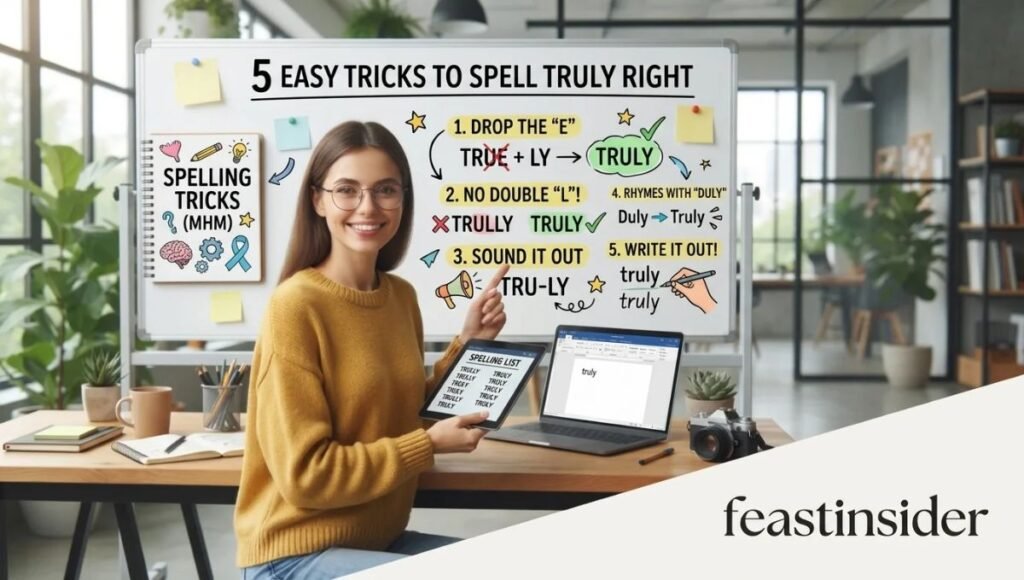
These five tricks settle trully or truly for good:
- Build it step by step. Start with true, drop the e, add ly. The result is truly.
- Memorize the e-dropping family. Truly, duly, and wholly all lose their e.
- Check the last letter of the adjective. Double l happens only when the adjective ends in l (real, final). True ends in e.
- Say it slowly. TROO-lee has one “l” sound, so it gets one l.
- Try the meaning test. If “genuinely” or “really” fits the sentence, the word you want is truly.
Real Examples of Truly in Sentences
Here is trully or truly settled in real sentences, with the right spelling in each.
Everyday: “I truly love this song.”
Workplace: “We truly appreciate your quick response.”
Email: “I am truly sorry for the delay, and I will send the file today.”
Business writing: “The new tool is truly useful for small teams.”
Academic: “The results are only truly meaningful when the sample is large.”
Formal: “The committee is truly grateful for your service.”
Casual: “That pizza was truly the best I have ever had.”
In the email example, “truly” strengthens “sorry.” In the academic example, it modifies the adjective “meaningful,” and it sits right before that adjective.
What Does “Yours Truly” Mean?
“Yours truly” is a traditional closing for letters and emails. Write it with a capital Y, a lowercase t, and a comma: “Yours truly,”. A formal variation is “Very truly yours.”
The same trully or truly question appears in this closing, so use one l there too.
In casual speech, “yours truly” can also mean “me” in a playful way: “Yours truly will handle the dishes tonight.” In British letter writing, “Yours sincerely” and “Yours faithfully” are the more common formal closings.
Related Words and Spellings
Words in the same family help lock in the spelling after the trully or truly question:
- true (adjective): “That is a true story.”
- truth (noun): “Tell me the truth.”
- truthful (adjective): “She gave a truthful answer.”
- truthfully (adverb): “Truthfully, I forgot.”
- untrue (adjective): “The rumor is untrue.”
- duly and wholly: other adverbs that drop the e
Notice that “truthfully” keeps the e from “true” out entirely because it builds on truth, not on true. That makes it a separate word with its own spelling.
Common Truly Spelling Mistakes
Beyond trully or truly, two related slips show up often.
Incorrect: “I trully appreciate it.”
Correct: “I truly appreciate it.”
There is only one l before the y.
Incorrect: “Thank you truely.”
Correct: “Thank you truly.”
The e from true disappears.
Incorrect: “Yours trully,”
Correct: “Yours truly,”
The closing uses the same spelling as the adverb.
Where Does Truly Come From?
Truly goes back to Old English, where it was formed from a word for true plus the adverb ending -ly. The older meaning of true was closer to “faithful” or “trustworthy” than to “factually correct.”
American and British English use the same spelling for truly. No regional variation exists.
Frequently Asked Questions
Is it trully or truly in an email closing?
It is truly. Write “Yours truly,” with one l and no e.
Is “trully” a word?
No. “Trully” is a misspelling of “truly.”
Is “truely” correct?
No. The e from “true” is dropped before -ly, so the correct form is “truly.”
What part of speech is truly?
Truly is an adverb. It modifies verbs, adjectives, and other adverbs, as in “She truly cares” and “a truly great idea.”
The One Spelling to Remember
The answer to trully or truly is truly: one l, no e.
Drop the e from true, add ly, and stop: truly.







1 thought on “Truly or Trully? Which Spelling Is Correct? (5 Easy Tricks) ”