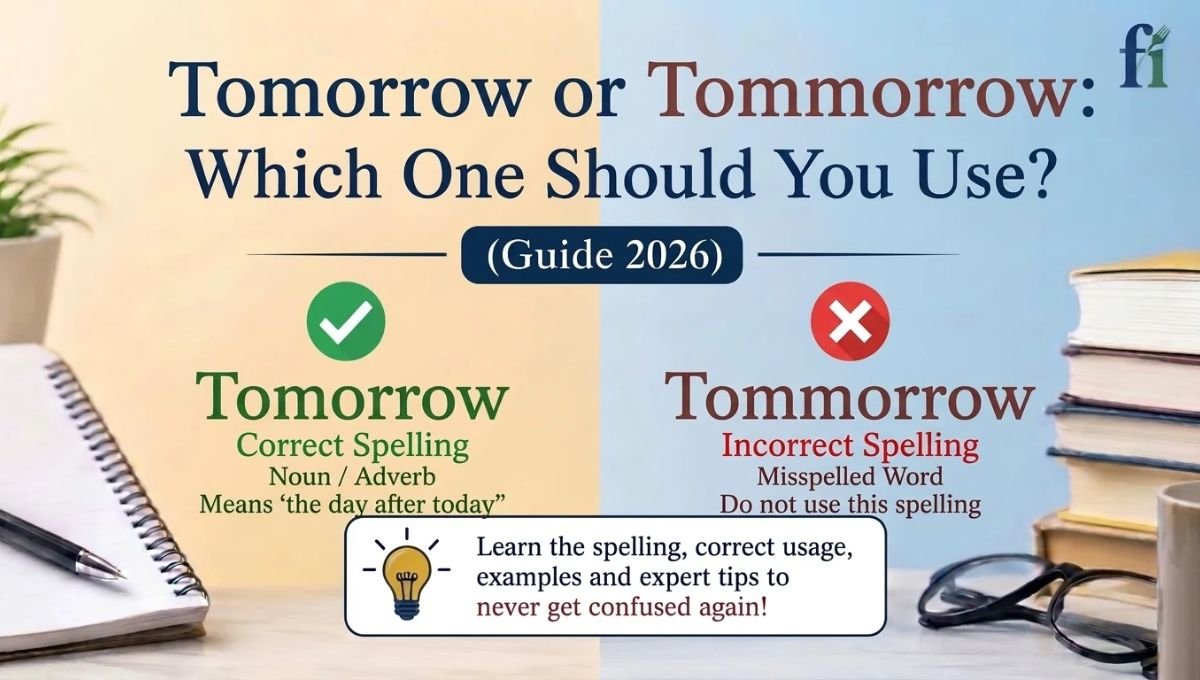
You type a quick text, glance at the screen, and wonder if that second m belongs there. It’s an easy slip, because the word sounds like it has a doubled consonant. The answer for Tomorrow vs Tommorrow is simple: tomorrow is the only correct spelling. It has one m and two r’s. This guide shows why, and how to lock it in, so the Tomorrow vs Tommorrow question never slows you down again.
Tomorrow vs Tommorrow: The Short Answer
“Tomorrow” is the correct spelling. “Tommorrow” is a misspelling. The word has one m and two r’s: t-o-m-o-r-r-o-w.
Standard dictionaries do not list “tommorrow” as a variant, a British spelling, or an old-fashioned form. If it shows up in your draft, it’s a typo, and the fix takes two seconds.
The rest of this guide covers the meaning, the logic behind the spelling, and a few habits that keep the extra m out of your writing.
What Does Tomorrow Mean?
Tomorrow means the day after today. If today is Monday, tomorrow is Tuesday.
The word also stretches to cover the future in a general sense. A phrase like “the leaders of tomorrow” points to the next generation, not to one calendar date.
Here are both senses in action:
- “The dentist appointment is tomorrow at 9 a.m.”
- “Today’s choices shape tomorrow’s opportunities.”
The first sentence names a specific day. The second talks about the future more broadly.
Why Tommorrow Is Wrong
The extra m is easy to add. English has plenty of words with a doubled m, such as “summer,” “common,” and “commit,” so the pattern feels familiar. The stress also lands on the middle syllable, which makes the m sound strong when you say the word.
The real double letter is the r. It sits near the end of the word, where it’s easy to overlook. So the Tomorrow vs Tommorrow mix-up usually comes from putting a double letter in the wrong spot.
Does “tommorrow” have any legitimate use? No. It has no meaning in standard English. You might spot it in a brand name or a username, but those are creative choices, not spelling rules.
Tomorrow vs Tommorrow at a Glance
| Spelling | Correct? | Meaning | What to do |
| Tomorrow | Yes | The day after today, or the future | Use it in all writing |
| Tommorrow | No | None, it is a misspelling | Replace it |
| Tommorow | No | None, extra m and missing r | Replace it |
| Tomorow | No | None, missing r | Replace it |
Every wrong version breaks the same pair of rules: one m, two r’s.
Tomorrow as Noun and Adverb
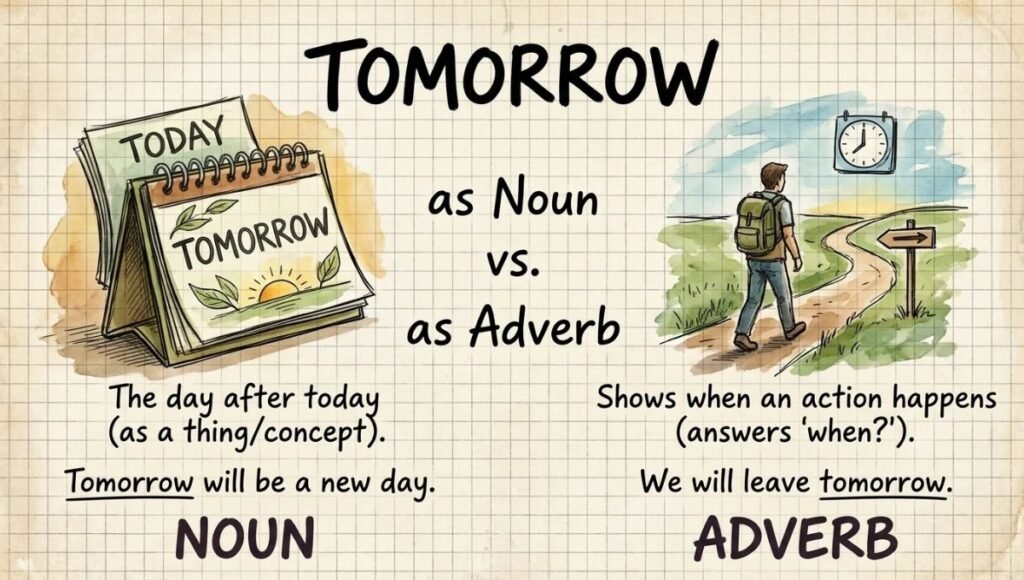
Tomorrow does two jobs in a sentence.
As a noun, it names the day: “Tomorrow is a holiday.” It can also take a possessive: “I checked tomorrow’s forecast.” The plural, “tomorrows,” is rare and mostly figurative, as in “brighter tomorrows.”
As an adverb, it tells when something happens: “We launch tomorrow.” You will also see it before other time words, as in “tomorrow morning” and “tomorrow night.”
There is no verb or adjective form. The spelling is the same in American and British English, and you capitalize it only at the start of a sentence or in a title.
One usage tip for formal writing: when you report past events, use “the next day” or “the following day” instead. For example, write “She said she would call the next day,” not “She said she would call tomorrow.”
Where Tomorrow Comes From
Tomorrow started out as two words. In Old English, “tō morgenne” meant roughly “in the morning” (from “tō” plus “morgen,” the ancestor of “morning”). By Middle English, “morgen” had softened to “morwe,” and then to “morrow,” which came to mean “the next day.”
Put “to” and “morrow” together and you get the modern word. Many older books print it as “to-morrow” with a hyphen, the same way they printed “to-day” and “to-night.” Modern American English uses one word with no hyphen.
The word “morrow” still survives in phrases like “on the morrow.” Seeing the roots makes the Tomorrow vs Tommorrow choice easier: “morrow” has one m and two r’s, so the full word does too.
More related Terms: Drier or Dryer? 1 Simple Rule Settles It (Plus 4 Quick Checks) https://feastinsidar.com/drier-or-dryer/
How to Pronounce Tomorrow
Most Americans say tuh-MAR-oh or tuh-MOR-oh. The stress falls on the middle syllable, and the first syllable is a soft “uh.”
The word has three syllables: to, mor, row. Notice that the r sits on both sides of the syllable break (mor-row). That is exactly where the double r comes from.
Because Tomorrow vs Tommorrow sounds identical out loud, the mistake only shows up in writing. Your ear can’t catch it, so your eyes have to.
Tomorrow in Real Sentences
Here is how the Tomorrow vs Tommorrow choice plays out in everyday writing, where only one spelling belongs.

Everyday conversation
- “Are you free for coffee tomorrow?”
- “Tomorrow is another day.”
Casual texting
- “Can’t wait for the game tomorrow!”
Workplace and email
- “Please send the updated report by noon tomorrow.”
- “I’ll follow up tomorrow morning with the revised schedule.”
Business writing
- “Tomorrow’s meeting has moved to Conference Room B.”
Academic writing
- “The study group meets tomorrow to review chapter four.”
Formal writing
- “The committee will announce its decision tomorrow.”
In “Tomorrow’s meeting,” the apostrophe s shows possession, not a plural. In the committee sentence, “tomorrow” is an adverb that tells when the announcement happens.
Common Spelling Mistakes
Almost everyone has made this slip once. It’s a normal typo, so treat it as a quick fix.
Incorrect: I’ll send the invoice tommorrow.
Correct: I’ll send the invoice tomorrow.
Only one m belongs in the word.
Incorrect: See you tomorow!
Correct: See you tomorrow!
The word needs both r’s.
Incorrect: Tommorow’s agenda is ready.
Correct: Tomorrow’s agenda is ready.
The possessive keeps the same base spelling.
Related Words and Phrases
Tomorrow belongs to a small family of time words:
- Related terms: today, tonight, yesterday, the day after tomorrow
- Common phrases: see you tomorrow, tomorrow morning, tomorrow night, same time tomorrow
- Idioms: “Tomorrow is another day,” “Tomorrow never comes,” “the world of tomorrow”
- Past-tense stand-ins: the next day, the following day
- Older forms: to-morrow, “the morrow”
Other misspellings you may run into include “tomarrow” and “tommorrow.” All of them break the one m, two r’s pattern.
Easy Memory Tricks
A few habits make the Tomorrow vs Tommorrow decision automatic:
- Split it into two parts. Think “to” plus “morrow.” Morrow is a real word with one m and two r’s.
- Say it by syllables. To-mor-row. The r repeats right at the break.
- Remember “two r’s in a row.” The word even ends in “row,” so the r’s stay together.
- Set up autocorrect. Add a rule that changes “tommorrow” to “tomorrow” on your phone and computer.
- Search before you publish. Run a quick find for “tomm” in your draft. It catches the most common wrong versions at once.
FAQs
Is “tommorrow” ever correct?
No. Tomorrow is the only standard spelling. “Tommorrow” is a typo with no meaning in English.
Is Tomorrow vs Tommorrow a US and UK difference?
No. American and British English both spell it “tomorrow.” Neither accepts “tommorrow.”
How many m’s and r’s does “tomorrow” have?
It has one m and two r’s.
How do I use “tomorrow” in a sentence?
Use it as a noun or an adverb. For example: “I’ll submit the form tomorrow” (adverb) or “Tomorrow is my day off” (noun).
The Takeaway
In the Tomorrow vs Tommorrow debate, there is only one winner: tomorrow, with one m and two r’s. Think “two r’s in a row,” and you’ll spell it right every time.








1 thought on “5 Quick Tricks to Settle Tomorrow vs Tommorrow for Good”