
Referred or Refered: which spelling do you type? Most past tense verbs simply add “-ed,” so “refered” looks logical. It is not. The correct spelling is referred, with a double r. Whenever you face Referred or Refered in a draft, choose the double r form. A quick stress rule explains why, and it works for several other verbs too.
Referred or Refered: Which Spelling Is Correct?
Referred is correct. Refered is a misspelling. Referred is the past tense and past participle of the verb “refer,” and it always has two r’s in the middle.
Standard dictionaries do not list “refered” as a variant, an older spelling, or a British form. If your spell checker underlines it, trust the red line.
The fix takes five seconds. Wherever you typed “refered,” change it to referred. The same goes for “refering,” which should be referring.
What Does Referred Mean?
“Refer” has several related meanings, and “referred” carries each of them into the past:
- To mention or point to something: “The speaker referred to last year’s results.”
- To send someone to a person or source for help: “My doctor referred me to a specialist.”
- To consult something for information: “I referred to the manual before calling support.”
- To apply to or describe: “The old term referred to a job that no longer exists.”
The core idea is always the same: directing attention or a person somewhere else. Close synonyms include mentioned, cited, alluded to, directed, and consulted.
Why Does Referred Have Two R’s? The Spelling Rule
The double r comes from a standard English spelling rule. When a verb ends in a single vowel plus a single consonant, and the stress falls on the final syllable, you double the final consonant before adding “-ed” or “-ing.”
Say “refer” out loud: re-FER. The stress lands on the last syllable, and the word ends in a vowel plus r. So the r doubles: referred, referring. That one rule settles the Referred or Refered question for good.
Now compare “offer.” It is pronounced OF-fer, with the stress on the first syllable. The rule does not apply, so you write “offered” and “offering” with a single r.
Referred or Refered at a Glance: Quick Comparison Table
| Term | Correct? | Meaning | Use |
| Referred | Yes | Past tense and past participle of “refer” | “She referred me to a lawyer.” |
| Referring | Yes | Present participle of “refer” | “I am referring to page 12.” |
| Refers | Yes | Third person singular, present tense | “The term refers to a small fee.” |
| Refered | No | Misspelling with no meaning | Replace with “referred” |
| Refering | No | Misspelling with no meaning | Replace with “referring” |
Notice that “refers” is correct with a single r. The doubling only happens when a suffix starting with a vowel, like “-ed” or “-ing,” gets added.
More related Terms: Emaculate vs Immaculate: Which Is Correct? Meaning, Spelling, and 10 Usage Examples https://feastinsidar.com/emaculate-vs-immaculate/
How Do You Pronounce Referred?
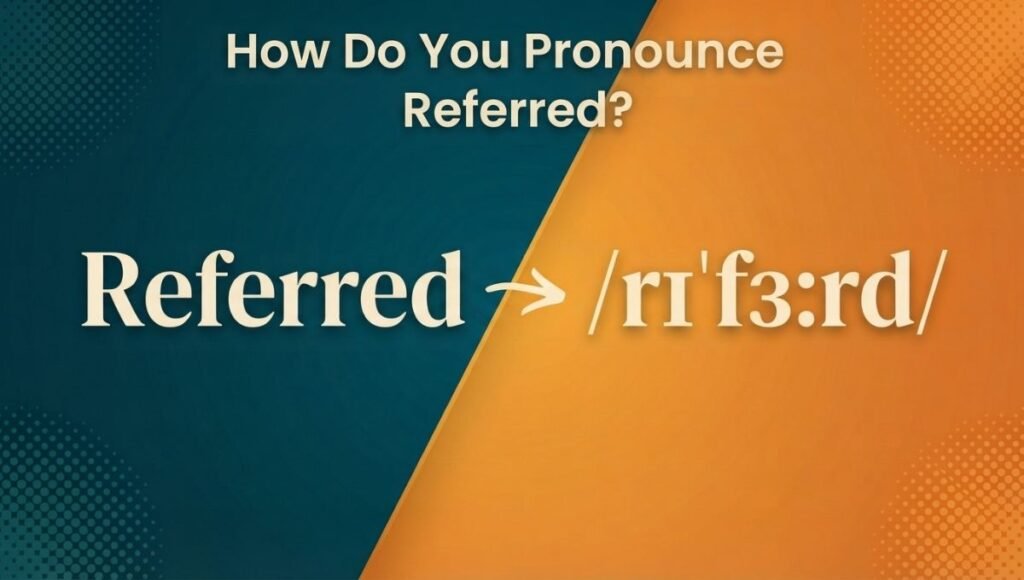
In American English, referred is pronounced rih-FURD. It has two syllables, and the stress falls on the second one: re-FERRED.
The “-ed” ending sounds like a simple “d.” You do not add an extra syllable, so it never sounds like “re-fer-ed” with three beats.
That stressed final syllable is exactly why the r doubles in writing. The spelling follows the sound pattern.
What Part of Speech Is Refer? Verb Forms and Tenses
“Refer” is a verb. It usually travels with the preposition “to” when you mean mention or point toward something (“refer to the chart”). It can also take a direct object when you send someone somewhere (“refer a patient”).
Here are its forms:
- Base form: refer
- Third person singular: refers
- Past tense: referred
- Past participle: referred (as in “has referred” or “was referred”)
- Present participle: referring
Related nouns follow the same logic. Referral (a recommendation to another person or service) and referrer (someone who refers) both keep the double r, because the stress still falls on “fer.”
The spelling is identical in American and British English. Neither variety accepts “refered.” The word works in formal and informal writing alike.
Where Does the Word Refer Come From?
“Refer” comes from the Latin verb referre, which combines re- (back) and ferre (to carry). It reached English through Middle French. The literal idea of “carrying back” to a source still shows up today when you send someone back to an expert or a document.
The root ferre appears in many other English verbs, including transfer, prefer, defer, confer, and infer. Most of them share the same spelling pattern, which is useful to know (more on that below).
How Do You Use Referred in a Sentence? 7 Real Examples
Everyday conversation
- “My neighbor referred me to a great plumber.”
- “I referred back to my notes and found the answer.”
Workplace communication
- “In yesterday’s meeting, Marcus referred to the budget twice.”
Emails
- “Hi Jordan, Dr. Patel referred me to your clinic for a follow up.”
Academic writing
- “The author referred to three earlier studies without citing them.”
Business writing
- “Satisfied customers have referred several new clients to our firm.”
Formal writing
- “The case was referred to the appeals court for review.”
A quick note on why these work. In examples 1 and 4, “referred me to” follows the pattern verb + person + “to” + destination. In example 3, “referred to” means mentioned. In example 7, the sentence is passive (“was referred”), and the past participle still takes the double r.
What Are the Most Common Referred Mistakes?
The Referred or Refered slip is the most frequent error, but it is not the only one. These are normal learning mistakes, and each has a simple fix.
Incorrect: She refered me to a specialist.
Correct: She referred me to a specialist.
The stress is on the last syllable, so the r doubles.
Incorrect: I am refering to the attached file.
Correct: I am referring to the attached file.
The same rule applies before “-ing.”
Incorrect: The referal came from my doctor.
Correct: The referral came from my doctor.
The noun keeps the double r because the stress still falls on “fer.”
Incorrect: Please see the referrence section.
Correct: Please see the reference section.
Here the stress moves to the first syllable (REF-er-ence), so no doubling happens.
Incorrect: She offerred me the job.
Correct: She offered me the job.
This is an overcorrection. “Offer” stresses the first syllable, so the r stays single.
Which Similar Verbs Double the Final Consonant (and Which Do Not)?
Once you know the rule, you can spell dozens of verbs correctly. These verbs stress the last syllable, so they double the final consonant:
- prefer → preferred, preferring
- defer → deferred, deferring
- confer → conferred, conferring
- transfer → transferred, transferring
- infer → inferred, inferring
- occur → occurred, occurring
- admit → admitted, admitting
These verbs stress the first syllable, so they do not double:
- offer → offered, offering
- differ → differed, differing
- suffer → suffered, suffering
- answer → answered, answering
- visit → visited, visiting
The noun forms “reference,” “preference,” and “conference” also stress the first syllable, which is why they have a single r after “fe.” The related adjective “preferable” works the same way.
One technical footnote: the web header “Referer” (used in internet protocols) is spelled with a single r because of an early misspelling that became permanent. Outside of that technical term, the standard English word is “referrer.”
How Can You Remember Referred or Refered?
Here are three simple ways to settle Referred or Refered whenever you doubt yourself:
- Count the r’s. Referred has three r’s in total: one at the start and two together in the middle. If you only see two, something is missing.
- Pair it with “preferred.” Most people spell “preferred” correctly without thinking. Refer and prefer follow the same pattern, so copy it.
- Say it out loud. The stress lands on the last syllable (re-FER), and that stress is your signal to double the r.
FAQ
Is “refered” a real word?
No. “Refered” is a misspelling of referred. It does not appear in standard American or British dictionaries.
Is Referred or Refered a spelling difference between American and British English?
No. Both varieties use referred. The doubling rule applies the same way on both sides of the Atlantic.
What is the past tense of refer?
The past tense of refer is referred. The past participle is also referred, as in “She has referred many clients to us.”
Is it “referring” or “refering”?
The correct spelling is referring. The final r doubles before “-ing” for the same reason it doubles before “-ed.”
The Takeaway: Spell It Referred
In the Referred or Refered choice, only one spelling is correct: referred, with a double r. The verb “refer” stresses its last syllable, so the final consonant doubles before “-ed” and “-ing.”








1 thought on “Referred or Refered: How to Spell It Correctly in 2026 (1 Simple Rule + 7 Examples)”