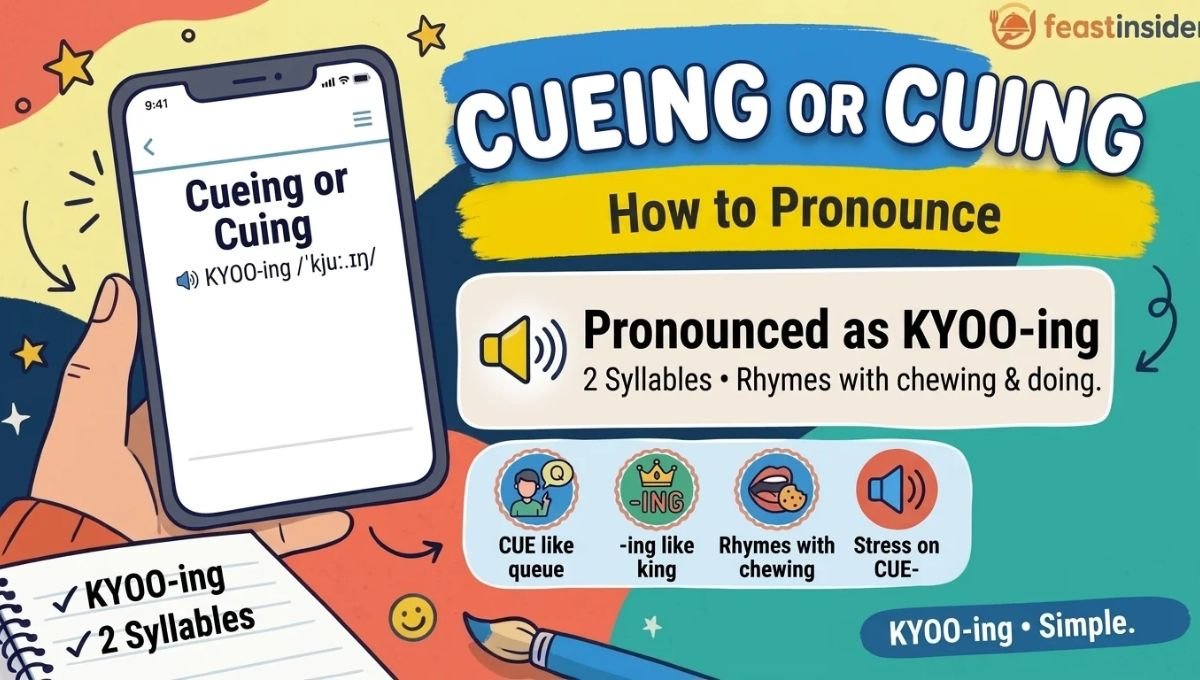
You type “cueing,” and your spellchecker stays quiet. You type “cuing,” and it stays quiet again. So which one is right, cueing or cuing? The confusion exists because English usually drops a silent e before -ing, yet “cue” can keep it. Cueing and cuing are both correct spellings of the present participle of “cue.” The only rule for cueing or cuing is to pick one and use it consistently.
Cueing or Cuing: The Quick Answer
Both “cueing” and “cuing” are correct. They are alternate spellings of the present participle of the verb “cue,” and neither one is a mistake.
They mean exactly the same thing:
- “The director is cueing the lights.”
- “The director is cuing the lights.”
Your job is not to find the right one. It is to choose one spelling and stick with it.
Why Do Two Spellings Exist?
English has a standard rule: drop a silent e before adding -ing. Make becomes making, and argue becomes arguing. Following that rule, cue becomes cuing.
Some writers keep the e anyway, producing cueing. One common reason is readability: “cuing” is a short, unusual string of letters, and the extra e makes the base word easier to spot.
Other words show the same split. Queue can become queuing or queueing, and glue can become gluing or glueing. Seeing the rule behind cueing or cuing makes the split feel less mysterious.
What Does Cue Mean?
As a verb, cue means to give a signal that tells someone to start, or to prompt a person or a piece of equipment.
- To signal someone: “She cued the actor to enter.”
- To prompt: “A reminder cued him to call back.”
- To prepare playback: “He cued up the next track.”
As a noun, a cue is a signal or hint: “That yawn was my cue to leave.” Both spellings are pronounced the same way: KYOO-ing.
Verb Forms of Cue
Only one form of this verb has two accepted spellings. Here are all of them:
| Form | Name | Example |
| cue | Base form | “I cue the music.” |
| cues | Third person singular | “She cues the lights.” |
| cued | Past tense and past participle | “He cued the singer.” |
| cueing / cuing | Present participle | “They are cueing the choir.” |
Only the -ing form creates the cueing or cuing question. The past tense is always cued, never “cueed.”
Cueing vs Cuing at a Glance
Here is cueing or cuing in one view, along with two look-alikes:
| Form | Correct? | Meaning | Use |
| cueing | Yes | Giving a signal or prompt | Keeps the e before -ing |
| cuing | Yes | Giving a signal or prompt | Drops the e, following the usual rule |
| queuing / queueing | Yes (different word) | Waiting in line | Not interchangeable with cueing |
| cueed | No | None | Past tense of cue is “cued” |
Which Spelling Is More Common in the US and UK?
Both spellings appear in American and British English, and major dictionaries list both. Unlike words such as “color” and “colour,” neither spelling works as a reliable marker of one country.
For cueing or cuing, region is not the deciding factor. Style is. Many publications, companies, and editors set their own preference, so check your style guide first.
More Terms: Choosen or Chosen? 4 Simple Tricks to Get the Spelling Right https://feastinsidar.com/choosen-or-chosen/
5 Tips to Pick the Right Spelling
These five tips settle cueing or cuing for any project:
- Check the style guide. If an editor, client, or publication has a preference, follow it.
- Match existing content. If your site or document already uses one spelling, use the same one.
- Stay consistent. Choose one form and apply it throughout the entire piece.
- Pick what reads cleanly. Both are correct, so choose the one that looks natural to you and your audience.
- Check the word itself. Make sure you mean “cue” (a signal) and not “queue” (a line).
Real Examples of Cueing and Cuing

Here is cueing or cuing in realistic sentences. These examples alternate spellings only to show both forms. In your own writing, pick one.
Everyday: “I am cueing up the next song.”
Casual: “Thanks for cuing me on his name.”
Workplace: “The stage manager is cueing the lights for scene two.”
Email: “I am cuing up the slides now, so please join the call.”
Business writing: “Our team is cueing the product demo before the board meeting.”
Academic: “The lesson focuses on cuing strategies for memory retrieval.”
Formal: “Cueing the choir remains the conductor’s responsibility.”
In the email example, “cuing up” means preparing the slides to start. In the academic example, “cuing” works as part of a noun phrase (cuing strategies), and in the formal example it works as a gerund (a verb form used as a noun).
Cue or Queue: Do Not Mix Them Up
These words sound identical but mean different things. A cue is a signal or prompt. A queue is a line of people or things waiting, and as a verb it means to wait in line.
Do not let cueing or cuing blur into queuing or queueing, which have their own spelling pair.
- “The stage manager is cueing the next scene.” (signal)
- “Customers are queuing outside the store.” (waiting in line)
The phrasal verbs differ too: “cue up a song” means to prepare it to play, while “queue up” means to line up or add something to a waiting list.
Common Mistakes With Cue Forms
Beyond cueing or cuing, these slips come up often.
Incorrect: “The director is cueeing the actors.”
Correct: “The director is cueing the actors.”
The word keeps only one e before -ing.
Incorrect: “The director cueed the lights.”
Correct: “The director cued the lights.”
Cue adds -d for the past tense, not -ed.
Incorrect: “Please cue up at the counter.”
Correct: “Please queue up at the counter.”
Waiting in line calls for queue.
Where Does Cue Come From?
The history of cueing or cuing starts with the noun, whose origin dictionaries describe as uncertain. One frequently cited idea links it to the letter Q marked in actors’ scripts. Treat that as a theory, not a settled fact.
The billiards “cue” is a different word. It comes from the French word for “tail,” which is the same source as “queue.” The two senses of cue simply ended up with the same spelling in English.
Frequently Asked Questions
Is it cueing or cuing in American English?
Both are accepted in American English. Choose one and use it consistently.
Is “cuing” a real word?
Yes. It is an accepted spelling of the present participle of “cue,” alongside “cueing.”
What is the past tense of cue?
The past tense is “cued.” Example: “She cued the band at exactly 8 p.m.”
Is “cue up” the same as “queue up”?
No. “Cue up” means to prepare something to start, while “queue up” means to line up or join a waiting list.
The Simple Rule for Cue Spellings
The answer to cueing or cuing is that both are right. Keep the e or drop it, but stay consistent.
Both spellings are correct, so choose one and use it everywhere.







1 thought on “Cueing or Cuing? Which Spelling Is Correct? (5 Easy Tips) ”